Showing posts with label Non-fiction. Show all posts

Monday, March 3, 2014

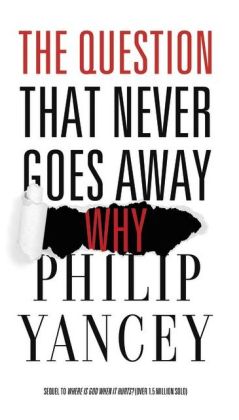
The Question that Never Goes Away, by Philip Yancy


The Question that Never Goes Away, by Philip Yancy

Genre: Christian Living

Reason for Reading: A galley copy of this book was provided by Netgalley in exchange for an honest review. I wanted to read this book because I'm interested in theodicy, and I've been pretty impressed with the bits of Yancy's writing that I've seen.

Synopsis: After over a decade of traveling the world giving lectures on Where is God When it Hurts, Philip Yancy has decided to revisit this subject in his most recent book The Question That Never Goes Away. I have not read his earlier book, so I can't compare the messages of each, but I assume the newer book has a similar message to the older, with recent examples and insights that he has gathered since writing the first book. 

He starts by describing two different types of disaster: the devastating 2011 tsunami in Japan and the horrifying 4-year seige of Sarajevo in 1992. The first example is a natural disaster, but the second is man-made. Such disasters beg the question "Why?" Why would a God who loves us allow such destruction?

Yancy points out that atheists have a field day with such calamity - using it as evidence that God doesn't exist. For, clearly, a loving God wouldn't allow such things to happen; therefore it is erroneous to believe in God. But Yancy counters: if, indeed, this is an impersonal universe of random indifference, why are the atheists so shocked and upset about someone else's tragedy? Clearly, their morals are shaped by the philosophical framework of Christianity. 

My thoughts: I don't really think this is an adequate counter to the claim that God doesn't exist. First of all, Christianity is not the only religion which is founded on the power of love. Second, there is no evidence that God created our revulsion to other peoples' tragedy. Such revulsion can be explained by evolution of social behavior. Humans might simply have an instinct to protect our neighbors because we are better able to survive in a group than alone. On the other hand, I don't think asking the age-old question "Why?" proves God doesn't exist, either. To think so is a bit naive.

Yancy continues by explaining that there's nothing wrong with asking the question "Why?" In fact, it is a question asked over and over again in the Bible. God expects such questions, and he understands our grief and frustration at getting no answer. BUT, He still doesn't provide an answer. Not in the Bible. And not in the world. 

Ours is not to reason why. Ours is but to do and die. 

Yancy suggests that we shift our focus from cause to response. When disaster strikes, we should appreciate the outpouring of humanitarian aide that comes from individuals, communities, and countries. Yes - some of this humanitarian aide can be poorly planned, but notice what lies at the heart: love. We, as human beings, want to reach out and help those who are suffering. So where is God when it hurts? He is in those friends, neighbors, and complete strangers who reach out to help the suffering. God hates our suffering as much as we do - but he loves us so much that he sent his own son to suffer among us. Because we can relate to a suffering God. 

Finally, Yancy criticizes the claim that God sends suffering in order to build character. He points out that Jesus healed the afflicted. He never once said to them "But think of how character-building this experience is!" Yancy points out that God has promised to redeem our suffering. This does not mean that God sends suffering, but that when tragedy occurs, He inspires and directs good to result from the evil. Thus, we do gain character from suffering. 

My thoughts: Well, I know for a fact that good often comes out of bad situations in my life. I don't know if that is only because I like to be optimistic and think of how I've learned from an experience, or become stronger, or had a good experience that otherwise never would have happened. I could just as easily dwell on the tragedy and what good that might have happened if tragedy hadn't occurred. If I did so, I would certainly live a more miserable life. But would I be any more right or wrong? Regardless, it makes me happy to think that God redeems my suffering. I'd rather not be miserable, thanks.

My thoughts: This is a very difficult book to read because Yancy dwells on quite a few tragic events in detail. However, the book has a strong message and is written with a very humble and personal air. Yancy impresses me with his intelligent observations and powerful examples. I highly recommend this book to anyone interested in the question of why God allows suffering. I am eager to read more of Yancy's work.

Tuesday, February 18, 2014

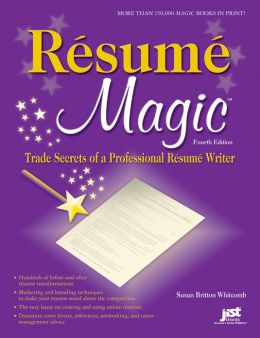
Resume Magic, by Susan Britton Whitcomb


Resume Magic, by Susan Britton Whitcomb

Genre: Self-Improvement - Job Hunt


Reason for Reading: Trying to buff up my resume so that I feel more presentable.


Synopsis: This book contains a lot of information about content and format of resumes. It starts by encouraging the reader to find his or her own personal brand, so that it can shine through on the resume. Then, Whitcomb discusses the differences between a chronological resume and a functional resume and provides suggestions about when each type of resume would be helpful. She helps the reader create an outline of the resume, later fleshing it out with helpful tips about content. She emphasizes the importance of listing accomplishments. Finally, she dwells on proof-reading. She provides a guide of the basic grammar and punctuation mistakes people make while writing resumes. The final few chapters outline her thought on job search through social media and on cover letters. These sections, of course, aren't as thorough as the chapters about resumes, but I think she's trying to whet our appetites for her other books..which I hear are just as thorough.


My thoughts: First. DON'T get the ebook! Get a hard-copy, because the figures and tables are really tiny in ebook format. Second, this book did not really have a lot of information that was relevant to writing a CV, for those of us who have a PhD. Although Whitcomb provided examples of resumes for a large variety of job types, she focused primarily on business, sales, and marketing. Sometimes I wondered if her tips applied to me or not. However, the book DID provide enough information for me to make my resume more presentable. Third, the title. Ouch. I almost didn't buy this book because the title was too pretentious. Fourth, Whitcomb was a bit heavy-handed with her self-marketing: Resume Magic often read like an advertisement for Whitcomb's webpage and other books. 


And now I see that my thoughts are rather top-heavy in criticism. I hadn't intended my review to be negative. Resume Magic is loaded with information and tips, and I'm much happier with my CV now than I was before reading this book. Resumes and job hunting have changed dramatically in the last few years, and books like these are very helpful for catching up on what employers are expecting. Because, let's face it, first impressions are a LOT about presentation. And don't we all want to make a good first impression?


I haven't read any other resume books, and I don't have the time to do so right now, so I can't very easily compare this to other books on the market. I have been reading Joyce Lain Kennedy's Job Interviews for Dummies and Job Search Letters for Dummies, though, so I can make a guess at what her Resumes for Dummies is like. My guess is that Whitcomb's book is more heavy in specific tips, and Kennedy's books tend to be more general. They both provide a lot of good examples, and they both explain what makes those examples stand out. But Whitcomb's style is more self-aggrandizing and opinionated. Kennedy recommends books by authors other than herself (including Whitcomb!), which makes her advice seem more sincere and approachable. So I guess if you're trying to choose between the two - pick Whitcomb if you want a book heavy in information, and Kennedy if you want more general advice from someone who's willing to reference opinions other than her own (even when they do not exactly coincide with her own).  


Tips that most helped me in my resume redesign:

Content


  • I am applying to several different types of jobs, mostly branching out from my degree in science. Each job type requires a different set of basic skills, so I prepared a few basic resume types, each arranged in a way that accentuated the traits requested by each job type.
  • In order to determine the what skills to emphasize in each resume type, I searched the internet for job listings and company mission statements to determine what is required for a good candidate in each job type.
  • Each time I apply for a job, I change my "qualifications" section, so that it directly reflects the skills requested by the job listing as well as the mission statement of the employer.
  • I emphasized numbers-based accomplishments for each job that I listed.
  • I did not include affiliations or bio, since this information made my resume way too long. So I've decided to include a link to my blog bio (which I am currently re-writing). Thus, my potential employers can get a sense of my "personal brand." 
Formating
  • I put my strongest attributes / qualifications in the visual center of the first page (just below the name and contact information), drawing further attention by setting this section off with lines.
  • I included a keyword section for electronically submitted resumes.
  • I created two versions of the resume - one for printing off, and one for submitting on the internet. The one for submitting on the internet must have very common fonts, and minimal fancy formatting (avoid tables, for instance).
Looking ahead
  • Although I certainly hope that whatever job I find will be long-term, I am going to start a file of all accomplishments, evaluations, letters / memos of approval, etc. This information might come in handy in the future. I'd never thought of collecting it before!
Clearly, this is not an exhaustive list of the tips provided in Resume Magic, but these include the major changes I made to my resume. 


The most vital changes that were made to my resume after reading this book were that I made it more accomplishment-oriented, I learned how to direct the qualifications/special skills section towards a specific job, and (for most basic versions) I moved my retail and TA experience into a separate section from my research experience. Thus, I had a chronological "Research" section and a second chronological "Mentorship"section. This really tightened up the resume.

Monday, May 27, 2013

The Ghost Map, by Steven Johnson

The Ghost Map

Written by Steven Johnson, Narrated by Alan Sklar

Reason for Reading: Science, Religion, and History group read

Genre: Non-fiction - Medicine and History


Review
The Ghost Map follows Dr. John Snow on his quest to discover the cause of a terrible cholera outbreak in Victorian England. Johnson makes investigative epidemiology so interesting that I could almost see it dramatized (and fictionalized) into a TV show - people DO love their investigative TV! :) But that's beside the point, I guess. At the time of this outbreak in 1854, the popular theory for the spread of cholera was miasma - deathly air that carried disease. After a LOT of investigative footwork, Snow drew a map of the cholera outbreak, demonstrating that the pattern followed streets that led to a particular well (the Broad Street pump) rather than following a circular pattern you'd expect with the spread of bad air. This map, and the investigation leading up to its creation, revolutionized epidemiology. In fact, many consider Snow the "first epidemiologist." 

I really enjoyed this book. The writing was engaging (it had a few boring parts in the end when Johnson was describing the map in great detail - I think that may be a problem with listening to the audio book rather than actually reading it, though). The subject was fascinating. Sklar did a good job of narrating the book, and except for the very end with the description of the map, I was quite pleased with the book's audio version. If you have any interest in epidemiology, or the history of medicine, I highly recommend this book.

Saturday, May 11, 2013

How the Catholic Church Built Western Civilization, by Thomas E. Woods

How the Catholic Church Built Western Civilization

Written by Thomas E. Woods, Narrated by Barrett Whitener

Reason for Reading: I have an interest in Church history and history of religion. 

Review
How the Catholic Church Built Western Civilization is an apologetics treatise about how the Catholic Church contributed to the development of science, philosophy, art, and culture. For someone who has not read a lot of books on the subject - who wishes to be disabused of the belief that the Catholic Church shunned science and tried to halt the progression of culture - this book is an excellent introduction. It covers a wide variety of topics in a superficial survey of how the Church changed and promoted civilization. On the other hand, if you're like myself and are well-read on the subject, this book lacks depth. Although there was a wide variety of information discussed, there was very little that it discussed in greater detail than I already knew. Therefore, I would highly recommend this text to someone who'd like an introduction to the topic - it's well-written, well-researched, and interesting. But if you're looking for depth and detail, this may be worth just a quick read. 

This audiobook was well-narrated by Barrett Whitener. No complaints there! :)

Saturday, April 20, 2013

Song of the Vikings, by Nancy Marie Brown

Song of the Vikings: Snorri and the Making of Norse Myths

Written by Nancy Marie Brown

Reason for Reading: This book was provided by the LibraryThing Early Reviewers program in exchange for an honest review. 

Review
This engaging biography describes the life of Snorri Sturluson, a powerful 12th-century Icelandic chieftain and the author of the poetic Edda - one of the oldest surviving documents of Norse mythology. As a novice of Viking history, I found this book fascinating and informative - though I suspect that there is much speculation and Brown isn't always clear when she is speculating and when she has hard evidence for her claims. As such, I think this biography would be enjoyed by people who are interested in learning a bit about the Vikings, but not experts on the subject. 

Brown started each chapter out with a legend out of Snorri's Edda. Often, she told how this legend differs from other known versions and/or how it has affected modern culture. The rest of the book describes Snorri's life - his youth in the household of "the uncrowned King of Iceland," his marriage, his rise to political power, and his downfall. She seemed to get most of her hard evidence from a few primary documents and an outwardly biased biography written by Snorri's nephew, so often she had to fill in the gaps by saying "it's possible it happened more like this, since his nephew's story doesn't really jive with Snorri's personality." Of course, that makes me wonder if she had just as much positive bias towards Snorri as his nephew had negative bias. :) Overall, though, I'd say this biography was a success. When there is so little information available, and when the book is intended for a popular crowd rather than an academic one, such speculation is necessary - it makes the book more fun. 

Monday, March 25, 2013

Malcolm X: A Life of Reinvention, by Manning Marable

Malcolm X: A Life of Reinvention

Written by Manning Marable, Narrated by G. Valmont Thomas

Reason for Reading: This was one of the books I'd listed as potential reading for my Social Justice Theme Read in February. I chose it because it won the Pulitzer Prize for History in 2012 and was a finalist in the National Book Award.


Review
In Malcolm X: A Life of Reinvention, Manning Marable set out to honestly portray a man and to humanize an icon. Marable intended on filling in holes left by truth-bending and necessary lack-of-future-knowledge in The Autobiography of Malcolm X. Since I am not an expert on the subject, I have to say that Marable's book seemed very thorough and well-researched. It was also an engrossing narrative. I feel it well-deserves its Pulitzer Prize. My only complaint was towards the beginning of the novel, Marable inserted some innuendo about Malcolm X's sexuality - which was unnecessary, and rather rude since he didn't have any hard evidence to support his claims. That innuendo was referenced obliquely a few times in the first quarter of the book. Luckily, those references stopped for the last three quarters of the book, or I would have been left with a very bad taste in my mouth.

The only reason I bring up that complaint is because I was looking for hints to why there's a controversy about this book. I was wondering if there was anything I, personally, could pick up. I'm not very familiar with what the controversy is about - and I haven't seen any controversial reference to the innuendo that bothered me. Mostly, the controversy seems to be about Marable's lack of respect for the impact Malcolm X had on the Black Liberation Movement. If you're interested, here's an interesting article on the topic. There's also a book entitled A Lie of Reinvention: Correcting Manning Marable's Malcolm X, if you really want to delve into the issue. However, I am satisfied that Marable did a lot of really good research, and wrote an interesting and informative book. The issue of exactly what long-term impact Malcolm X had on the Civil Rights Movement and the country as a whole is an opinion, in my opinion. 

G. Valmont Thomas did an excellent job of narrating this book. Quite enjoyable. :)

Tuesday, March 12, 2013

Mountains Beyond Mountains, by Tracy Kidder

Mountains Beyond Mountains

Written by Tracy Kidder, Narrated by Paul Michael

Reason for Reading: This was meant to be read for my Social Justice Theme in February, but things didn't work out quite as I'd planned. I finished the book in January, and haven't had the time to review it until now. :) Better late than never!

Review

In this moving biography of Paul Farmer, Tracy Kidder takes us on a world tour of medical missionary work. Farmer started his mission to save the world from tuberculosis one patient at a time in the slums of Haiti. Practically from scratch, he developed a clinic that would treat the poor. But Farmer not only treated his patients, he listened to them, he cared about each one with individual interest, and he provided food and supplies so that his patients wouldn't be saved from tuberculosis only to die of starvation.

As his mission in Haiti gained more and more momentum, Farmer's expertise on tuberculosis (especially antibiotic-resistant strains) became world-renowned. He was asked to help set up clinics in Peru. He worked with the health systems of prisons in Russia, where antibiotic-resistant tuberculosis was rampant. And he loved each and every patient, regardless of who they were. 

While describing the incredible non-stop work of Farmer, Kidder managed to make the doctor more human. I could imagine Farmer, cheerful despite sleep-deprivation shadows under his eyes, flying from one country to another in a worn-down suit that he would never have time to replace. From the book, it seemed that Farmer might pause for hours to have a heart-felt conversation with a patient, even while a room-full of self-important Harvard doctors awaited his arrival. I could empathize with Olivia, Farmer's old flame, who once felt a twinge of satisfaction to realize that Farmer was only human - she could annoy him. Being around someone like that must be exhausting. Kidder painted a brilliant man with limitless energy, unimpeachable morals, and the charisma to make his dreams a reality. I felt overwhelmed just listening to the book. :) I can't imagine what it must be like to work for him (or date/marry him). And yet, it's impossible for me to not admire him. 

I found this book fascinating not only because it was a description of an amazing man with a daring love for humanity, but also because I enjoyed learning more about the social/economic conditions of Haiti. The narrative flowed smoothly between Kidder's personal impressions of Farmer and Haiti to well-researched narratives of Farmer's life outside his work. 

I enjoyed Paul Micheal's narration of the book - though I have little to comment on his style of reading. It was one of those audiobooks that I was so absorbed in the story that I forget to be distracted by the narrator - which means Micheal must have done a good job. :)

Saturday, January 5, 2013

The Hour Between Dog and Wolf, by John Coates

The Hour Between Dog and Wolf: Risk Taking, Gut Feelings, and the Biology of Boom and Bust

Written by John Coates, Narrated by Paul Michael Garcia

Reason for Reading: This book was shortlisted for the Wellcome Trust Book Prize. 

Review
In this Wellcome Trust shortlisted book, Coates describes his research into the feedback loop between testosterone and success in the financial market. When a person has high levels of testosterone, they are prone to risk taking - which generally promotes the market; however, success raises their testosterone levels, which increases their risks and creates bubbles (like the dot-com bubble) which are unnatural and eventually pop. Loss of money leads to decreased testosterone levels and release of stress hormones - which, if sustained for long periods of time can lead to a depressed, risk-averse market. This is when the government should step in and perk up the market themselves. (You can probably guess Coates' politics from that statement, but the book is generally apolitical.)

I found Coates' research quite fascinating, and his writing was engaging to someone who's interested in the topic. I, unfortunately, am not generally interested in finance and so my attention wavered a bit during the finance-heavy bits. But the book was written in an approachable way such that I (who know nothing of the matter) could understand the financial/market bits and that someone who knows very little medicine could understand the science bits. In fact, it was shortlisted for the Wellcome Trust Book Prize because because it makes medicine approachable to the general population. For anyone interested in how hormones/neuroscience/psychology can affect the market, this would be an excellent book to pick up. An easy and interesting read. 

Wednesday, December 5, 2012

The Rape of Nanking, by Iris Chang

2012 Book 165: The Rape of Nanking

Written by Iris Chang, Narrated by Anna Fields

Reason for Reading: Reading Globally group on LibraryThing's China and surrounding countries theme read. 


Review
In the early 1930's the Chinese city of Nanking was occupied by Japanese soldiers. Tens of thousands of civilians were killed by Japanese soldiers to save money for supplies. Women were brutally raped and mutilated. But the stories of these victims and the foreigners who risked their lives to help them are not often told. Iris Chang wanted the world to know about these atrocities. Her brutal history was very difficult for me to read because the atrocities were described in such detail that I felt sick. I had to take frequent breaks. But it was a very engaging narrative, so I always wanted to pick it back up again. Chang certainly knew how to write an interesting story! Several times while reading the book, though, I felt as though Chang was too emotionally involved to write a completely reliable narrative. I'm not denying the massacres at Nanking, mind, but I think Chang had a very anti-Japanese view which would have made her prefer the larger estimates for death numbers, made especially-brutal rapes sound more common than they may have been, and made the Japanese sound purely evil as a whole group without exception. Nevertheless, this book taught me a lot about the relationship between the Chinese and the Japanese. As long as the readers keep in mind Chang's emotions, they can learn a lot from this engaging history.

I now have a hankering for a nice book about friendly, likable Japanese people. If you have any suggestions, let me know! :)


Thursday, November 15, 2012

Culture and Imperialism, by Edward W. Said

2012 Book 160: Culture and Imperialism

Written by Edward W. Said, Narrated by Peter Ganim

Reason for Reading: Got it on sale from Audible

Review
Culture and Imperialism describes how the language used in literature can powerfully impact our stereotypes of other cultures. Using examples in classical literature (ranging from Jane Austen, to Joseph Conrad, to Albert Camus), Said shows us how imperialism was reinforced by the written word. Then, (using examples including V.S. Naipaul and Salman Rushdie) he illuminates how today's societies - who are so focused on multi-culturalism - read the right books for the wrong reasons. I found this book intriguing. I listened to it on audiobook - Ganim's reading was smooth and engaging - but I'm now tempted to pick up a hard-copy of the book and use it as a reference in my perusal of literature. This book would be interesting to anyone interested in the culture of imperialism or in literary criticism of literature in the imperialist era.

Sunday, November 11, 2012

The House of Wisdom, by Jim Al-Khalili

2012 Book 156: The House of Wisdom, by Jim Al-Khalili

Reason for Reading: Science, Religion, and History group read on LibraryThing. 

Review
Many of us were taught that the origins of science were in Ancient Greece but that the Western World fell into the "Dark Ages" where science was lost and no progress was made. This traditional story concludes that the Western world rediscovered the Greek philosophies thus spurring on the Renaissance. A few months ago, I reviewed The Genesis of Science, by James Hannam, which was meant (partly) to dispel our notions of the Middle Ages as a time of darkness, a mire of progress. Hannam then describes how in the early years of the Renaissance, old scientific documents were rediscovered and translated. He only only briefly mentions the fact that those rediscoveries (and the ability to translate them) came from revitalized contact with the Arab world. The House of Wisdom fills that gap, by describing the ways in which the Arab world built upon the science of the Greeks, thus building the foundation for the scientific progress made during the Renaissance. I don't mean to say that Al-Khalili's book is only a gap-filler in the other book, but that the two books complement each other. The weaknesses in each are fortified by the strengths in the other. 

The House of Wisdom is an engrossing description of Ancient Arab history of science. Al-Khalili discusses the development of math, optics, medicine, chemistry, and philosophy by sketching descriptions of major scientific figures and their accomplishments. While Hannam's book tended to have a lot of gossipy digressions about the scholars, Al-Khalili tended to focus on facts that were more to the point. This makes Al-Khalili's book more informative, but less entertaining, than Hannam's book. For relief, All-Khalili inserts little passages about his own experiences in Iraq, which were helpful for lightening the mood. One thing I didn't like about Al-Khalili's book is that he is still stuck on the old-fashioned belief that the Western Middle Ages were dark and progress-free. And neither book covered the development of science in China or India. 

Overall, if you're interested in reading about Arabic science, I think this book is an excellent place to start. :)

Thursday, November 8, 2012

The Social Conquest of Earth, by Edward O. Wilson

2012 Book 154: The Social Conquest of Earth

Written by Edward O. Wilson, Narrated by Jonathan Hogan

Reason for Reading: Group read in our LibraryThing "Science, Religion, History" group


Review 
In The Social Conquest of Earth, Wilson expounds upon the theories that were set forth in his classic work Sociobiology. His main thesis is that group selection, not kin selection, drove evolution and helped us to develop societies. He compares the way human society developed to the way ant "society" developed (ants are his specialty). He suggests reasons why religion and xenophobia would have originally developed as protective characteristics of groups. This book covers a large swath of material...from ants to human prehistory, to history, to today. I think he did a pretty good job organizing the book considering what a wide topic he was covering. His theories were clear and for the most part convincing. I think Wilson is an atheist, but he did a pretty good job of stating his opinions in an agnostic sort of way to avoid insulting the faithful. The only statement that rather jarred me was when he suggested that there surely exist better ways to find spiritual fulfillment than total submission to God. This statement jarred me because it seemed he was saying that this religious process developed for a reason, but that reason is now obsolete. However, in an earlier chapter, he pointed out that homosexuality developed for a reason, so homophobia is not helpful to society. I wholeheartedly agree with him that homophobia is hateful and ignorant. But it is not particularly scientific to say homosexuality developed for a reason, therefore it's good...religion developed for a reason, but it's obsolete now. What are his reasons for deciding one is good and the other is obsolete? His reasons are emotional rather than scientific. But I'm just being nitpicky here. I think the book was well-written, interesting, and approachable by a non-scientific audience. I had no issues with Hogan's narration--he read the book well, but it wasn't anything worth raving about.

Tuesday, October 9, 2012

Surprised by Joy, by C. S. Lewis

2012 Book 144: Surprised by Joy

Written by C. S. Lewis, Narrated by Geoffrey Howard

Reason for Reading: I'm slowly working through the books of C. S. Lewis out of curiosity for his theology. 


Reveiw
In this short memoir, C. S. Lewis describes his spiritual journey from youthful atheist to firm and faithful believer. This isn't really a memoir of Lewis' life, although it does contain some interesting anecdotes about his school years. Mostly, he only focuses on incidents in his life that impacted his spiritual development. I have read many spiritual development memoirs, and this one is like the others...only it stands out because it is a classic. It was written when these types of journeys were not as commonly shared in memoirs. (In fact, I suspect that this book was one of the ones that inspired so many of the spiritual-journey memoirs that we see today.) One thing I found interesting about this book is it explained to me why so many people retro-diagnose Lewis with Asperger's syndrome. He talked about his difficulties dealing with other students...not knowing how to respond in social situations and being told to "take that look off [his] face" when he was trying very hard to keep an appropriate facial expression. I think it is important to recognize that we can't accurately retro-diagnose people with today's syndromes, but it IS interesting to see how such personality traits were present in Lewis' day, and how he excused them with stories about how childhood events affected his social interactions. It was definitely an interesting read...and anyone who likes to hear about others' spiritual journeys really should start with C. S. Lewis.


Thursday, September 6, 2012

Man's Search for Meaning, by Viktor Frankl


2012 Book 130: Man's Search for Meaning, by Viktor Frankl (9/5/2012)

Reason for Reading: One of the essays in Fantasy Media in the Classroom, talked about a fusion class which combined Man's Search for Meaning and The Lucifer Effect with science fiction books like The Invisible Man and The Strange case of Dr Jekyll and Mr Hyde in which men choose "evil." I thought since I've been reading a lot of books about men who choose "evil" that I'd try out Man's Search for Meaning. I'll try to fit in The Lucifer Effect soon. It gives an interesting perspective on why some people choose "good" and other choose "evil." Frankl's message was that people can choose to be "swine" or "saints," but they make this choice over and over throughout their lives and their search for meaning is the motivation behind each decision.

My Review
In the first half of this fascinating little book, Frankl describes his years in the concentration camps (including Auschwitz) with the purpose of analyzing the behavior of people in extreme situations. He admits that someone who wasn't there can't give a very detailed or personal account, but a person who WAS there can't give a detached account because they were emotionally involved. I think he did an excellent job of viewing the situation with detachment, considering the situation. This was a really interesting little memoir. The second half of the book introduces his theory of psychoanalysis: logotherapy. Logotherapy is focused on man's search for meaning; in contrast to Freudian theory focusing on man's search for pleasure and Adlerian theory focusing on man's search for power. I think Logotherapy is the most sensible form of psychotherapy I've ever heard of. How can I argue that our happiness depends on our perceiving our own purpose? I admit I felt a little skepticism when he kept bringing up examples of how he'd "cured" someone after only one session--he must have been a particularly clever person to manage that so often. ;) But that aside, I think the technique of finding meaning in a patient's life is rather useful. :)

Sunday, August 5, 2012

The Lemon Tree, by Sandy Tolan


2012 Book 118: The Lemon Tree: An Arab, a Jew, and the Heart of the Middle East, by Sandy Tolan (8/4/2012)

Reason for Reading: I realized I know much less than I should about this politically vital conflict and am enjoying learning more about it. I read this for the Reading Globally Middle Eastern Literature theme read.

My Review
Ostensibly, this is the (true) biography of the friendship between the Israeli woman Dalia Eshkenazi and the Palestinian man Bashir Khairi. However, the book also focuses strongly on background information--providing a wonderful history of the Israel-Palestine conflict since the 1940's. I was hugely pleased by this book for two reasons. First, the friendship between Dalia and Bashir was touching because they both had such strong nationalistic feelings. Somehow, despite their very different views, they were able to remain on good terms for many years. That's touching to me because many books with this let's-make-peace message tend to be about people who are all about love and peace and aren't as strongly influenced by their negative emotions as Dalia and (especially) Bashir. This is a friendship that was difficult to maintain, and yet it prevailed. The second reason I loved this book is because of the wonderful history of the region it provided. It's supposedly a "balanced" view--and it is, in the sense that it recommends justice (and sacrifice) be made by both sides. However, I'd say the book tended to be sympathetic towards to Palestinians. This SLIGHT bias is necessary in this case because many people in the Western world are over-exposed to the Israeli side and don't realize the Palestinians have a side at all. This book is highly recommended to anyone interested in the conflict.

Sunday, July 29, 2012

I Shall Not Hate, Izzeldin Abuelaish


2012 Book 112: I Shall Not Hate, by Izzeldin Abuelaish (7/23/2012)

Reason for Reading: Reading Globally Middle Eastern theme read

My Review 
In this heartbreaking (yet strangely uplifting) memoir, Abuelaish relates his life—growing up in poverty in a Palestinian refugee camp, slaving so that he could raise enough money to go to medical school, and his rising career coincident with his growing family. Despite losing 3 daughters and a niece to an Israeli military action, Abuelaish preaches that love, not hate, is required to bring peace. Abuelaish’s story is engrossing and tragic, yet I couldn’t help but think about all of the suffering Palestinians who don’t have a voice. If life is so hard for someone who has powerful connections, what must it be like for those who have no one to help them? This is a must-read for people who think Palestinians are all about terrorism and throwing rocks—people who likely wouldn’t touch the book with a 10-foot pole. It’s also a fantastic read for someone who is sympathetic to both sides of the conflict, but who wants to hear a personal story. I DO wish I could read the story of someone who isn’t highly connected, but this is a fantastic start. And Abuelaish’s enduring message of love make a monumental memoir.

Friday, July 13, 2012

Fantasy Media in the Classroom, ed. Emily Dial-Driver


2012 Book 107: Fantasy Media in the Classroom, ed. Emily Dial-Driver (7/12/2012)

Categories: Other

Reason for Reading: Early Reviewer's Book. 

My Review 4/5 stars
Fantasy Media in the Classroom is a collection of essays which describe why fantasy media and popular culture are useful in the classroom. For instance students can learn the same techniques using popular fiction as they can with an old-school class, but they feel more confident in their analyses because they already feel like they are experts on popular culture. These lessons and confidence can then be extrapolated on to classical literature. Fantasy Media in the Classroom also gives examples of how popular culture can be used to design lessons. This book was written mostly from the perspective of teaching college students, but a few essays talk about high school students. It's possible these lessons could also be changed a bit and used for younger students, as well. I think this book would be useful to teachers, even if they don't plan on fully incorporating popular culture in their classrooms, because it may help them to see the benefit of popular culture references their students make during class...and how such references could be embraced as an interesting interpretation rather than brushed off. I am not a teacher, but I found this book interesting because it helped me to better understand what fantasy media says about psychology/sociology/politics.

Thursday, July 12, 2012

Abraham, by Bruce Feiler


2012 Book 105: Abraham: A Journey to the Heart of Three Faiths, by Bruce Feiler (7/11/2012)

Reason for Reading: It fit into Reading Globally's Middle Eastern literature theme. 

My Review 3.5 stars
In this short work, Feiler reviews the Biblical story of Abraham and then describes how the myth of Abraham has changed over time and between the Abrahamic religions. It is well-written and interesting, and its length is well-suited for the amount of information Feiler wishes to convey. (There were no lengthy speculations in order to add bulk!) I enjoyed it and learned a little bit, too!

Friday, July 6, 2012

Cleopatra: A Life, by Stacy Schiff


2012 Book 99: Cleopatra: A Life, by Stacy Schiff (7/4/2012)

Reason for Reading: I needed to buff up my "Memoir and Biography" category in 12 in 12 group, and this book fit into the Reading Globally theme read for Middle Eastern literature since it took place in Egypt.

My Review: 3.5/5 stars
Cleopatra: A Life is a light biography which is appropriate for the popular reader...not so much for historians or people who have already read a lot on the subject. There is a lot of speculation (Schiff admits as much) because there is not a contemporary information on the topic. Schiff's thesis is that Cleopatra is not the conniving seductress that historians have suggested. The first third of the book covers her early life and relationship with Julius Ceasar, but this part not well organized. Schiff's narrative jumps from subject to subject and does not do a very good job of explaining the political background. In fact, this section focuses mainly on how rich Cleopatra was and dwells in great detail on opulence. The last two thirds of the book come together in a tighter, more interesting narrative, however. This is where Schiff discusses Cleopatra's relationship with Antony and its political ramifications. This is a good book to read for the "popular" reader who does't have a specific interest in the subject. However, I 'm guessing there may be biographies that better describe her relationship with Ceasar and the political ongoings at that time.

Monday, June 25, 2012

Cro-Magnon, Brian Fagan


2012 Book 93: Cro-Magnon, by Brian Fagan (6/24/2012)

Categories: Science

Reason for Reading: Interest in the evolution of humans

My Review 4/5 stars
Cro-Magnon, by Brian Fagan introduces what is currently known (and speculated) about Cro-Magnons and Neanderthals. Fagan spices up his narrative with imaginative vignettes of Neanderthals and Cro-Magnons as they may have lived. I imagine such vignettes would appeal to most everyone in the general public, including teens, though they may be a little irritating to a hard-core scientist who isn't interested in imaginative speculation (just a guess...I loved them!). Another excellent feature of this book is that it has incorporated historic scientific discoveries about prehistoric peoples with modern science like mitochondrial DNA tracing. Again, this feature would be of interest to most of the general public, but isn't meant for experts--there are a lot of simplifications for the sake of clarity. I think this book is an excellent introduction to prehistoric peoples that could be enjoyed by both adults and teens (even precocious pre-teens).