Showing posts with label Bible. Show all posts

Sunday, January 18, 2015

Lecture 1 of The New Testament (The Great Courses), by Bart D. Ehrman


The New Testament (The Great Courses, Course Number 656)

Lecture 1: The Early Christians and Their Literature

This was an introductory lecture which suggested a few ways to study the New Testament: 1) as a faithful believer; 2) From a cultural perspective (e.g. the NT's influence on Western culture and on literature); and 3) From the historical context of the initial audience. Erhman's course intends on studying the NT from the third perspective. 

He gives some background information: there are 27 books in the NT, all written by Christians of the 1st century. Many of these books claim to be written by direct apostles of Jesus (i.e. people who are considered to have been sent directly by Jesus to spread his word). All of the books were originally written in Greek.

The 27 books of the NT comprise 4 major groups. 1) The four Gospels, describing the birth, life, and death of Jesus; 2) The Acts of the Apostles, describing the spread of Christianity around the world; 3) 21 epistles, 13 of which are written by Paul, with a focus on the beliefs and ethics of Christianity; 4) The Book of Revelation, which is a piece of apocalyptic literature, originally thought to have been written by the apostle John, but later revealed to have been written by another John. (The belief that it was written by the apostle is why it attained popularity among early Christians.)

Texts read: 
The New Testament: A Historical Introduction to the Early Christian Writings, by Bart D. Ehrman - Chapter 1
The New Testament: A Student's Introduction by Steven Harris - Chapters 1 - 3
An Introduction to the New Testament, By Raymond Brown - Chapter 1
The New Testament Canon, by Harry Y Gamble

Chapter 3: The New Testament: A Student's Introduction, by Stephen Harris


In my final text for Lesson 1 of: The New Testament (The Great Courses, Course Number 656), I read chapters 1-3 of The New Testament: A Student's Introduction, by Stephen L. Harris. 

I found these notes from chapter 3 worth sharing, since I was unaware of the differences between these groups before reading this text: 

Chapter 3: The Diverse World of Fist-Century Judaism

Sadducees: Priests that conservatively stuck to a literal reading of the Torah, eschewing the "oral traditions" of the Pharisees. The Sadducees were the ones who turned Jesus over to the Romans for execution. They were the ones who stood the most to lose if there was fighting between the Romans and the Jews because the Sadducees seem to have been the chief mediators between the Roman rulers and the Jews. They disappeared after the sacking of Jerusalem by the Romans in 70CE.

Pharisees: These priests were also conservative, but they also had an oral law, which was later recorded as Mishnah in 200CE. Although there seems to be a lot of dispute between Jesus and the Pharisees in the Bible, Jesus most likely got along fine with most Pharisees (as can be seen in some Biblical stories). The disputes between Jesus and the Pharisees may have been biased by problems between the early Christians and the Pharisees around the time the Gospels were written.

Samaritins: This is a group of people (named after their capital city Samaria) related to the Jews by religion, but whom the Jews in Judea regarded as alien. Instead of worshiping at the Temple at Mount Zion, the Samaritins worshiped at Mount Gerizim. The Samaritins recognized only the Mosaic Torah, and not the Prophets or other biblical writings. 

Essenes: These are the people who are thought to have written the Dead Sea Scrolls somewhere between the mid-second century and late first century CE. Little is known about them, but their practices seem to have many similarities to later Christian practices, though Jesus is never mentioned outright. It is supposed by Harris that this is a non-Christian sect that anticipated some Christian rituals, rather than a group of early Christians. There also seem to be some parallels between the Book of Hebrews and Essenes' beliefs. 

Chapter 1: An Introduction to the New Testament, by Raymond E Brown


I've finished reading chapter 1 of An Introduction to the New Testament, by Raymond E Brown for the great course The New Testament (The Great Courses, Course Number 656), by Bart D. Ehrman. 

Notes on Chapter 1: 

The meaning of the word "Testament" has developed over time. At first, it was in reference to deals God had made with Noah, Abraham, David, and Moses - most notably the one to Moses in which the people of Israel were made "God's chosen people." Almost 600 years before the birth of Jesus, the prophet Jeremiah predicted "The days are coming when I will make a new covenant..." (Jer 31:31), where a covenant is a testament, and new means renewed. Then, before Jesus died, he referenced a new covenant/testament in his blood. Through his death and resurrection, therefore, Christians believed that god had renewed his covenant with his people, this time including the Gentiles. Only in the 2nd century do we see the word "testament" referring to a body of literature.

And, in fact, the idea of recording Jesus' story and sayings did not occur until after Jesus' death. Jesus didn't produce any written lectures, nor did he, in any of the Christian writings, suggest that his word be recorded. Letters were the first form of literature on Christian beliefs, and they were meant to answer immediate, pressing problems in the community to which they were addressed. Therefore, the letters of Paul have a different tone and emphasis in each, sometimes to the point of seeming contradictory. 

By the late 60s, anybody who had had direct contact with Jesus had died. The passing of the first generation of Christians led to writings of a more permanent nature. These include the deuteroPauline writings such as II Thes, Col, Eph, I and II Tim, and Titus, which were written after Paul's death. The deuteroPauline letters have a more permanent and universal tone than earlier letters. 

The Gospels also had a more permanent tone than early Pauline letters, but relevance to Christian problems would still have influenced which works were preserved. Mark's gospel emphasized the suffering of Christ on the cross, which would relate easily to the sufferings of early Christian persecution. The gospels of Matthew and Luke, probably written about 20 years later, are much more focused on the Jesus tradition, including sayings of Jesus which are hypothesized to originated in an earlier document dubbed "Q." 

The Acts of the Apostles was probably meant as a continuation of Luke's gospel. It moved the story of Christianity beyond Jerusalem and Judea to Samaria and beyond. 

The Book of Revelation is an example of apocalyptic literature with roots in Ezekiel and Zechariah. Apocalyptic literature was quite common at the time. Unfortunately, many modern readers have forgotten that the book was written to 1st century Christians, who would be quite familiar with the symbolic meaning of apocalyptic literature; they therefore interpret the Book of Revelation literally.

There are three reasons early Christian writings were preserved: 1) Apostolic origin - books that were purported to be written by apostles of Jesus (or Paul) had special place among Christians. 2) Which Christian communities the literature was addressed to - for instance, very little literature survives from Jerusalem or Judea, which was torn apart by the Jewish Revolt in 66-70. 3) Conformity with the rule of faith.

There is also a question of why we need 4 gospels instead of just 1. (This was discussed in my notes on Gamble's book.) Brown suggests that concentration on one gospel could be used to support theology rejected by a large number of Christians. An example of this problem is the beliefs of the Marcionites (also mentioned in detail in my notes on Gamble). The Marcionites believed that the creator God is not the same as the all-loving God of the NT. Therefore, the OT and teachings of Judaism should be rejected. Brown suggests that one reason the Church embraced four gospels was to refute Marcion's belief that only the gospel of Luke and the letters of Paul should be considered as canon. Brown also suggests that the Church embraced the OT to refute Marcion's rejection of it. However, in his book Gamble cautioned against putting too much emphasis on ONE driving factor for the Church's choices, and I agree with him on that.

Saturday, March 22, 2014

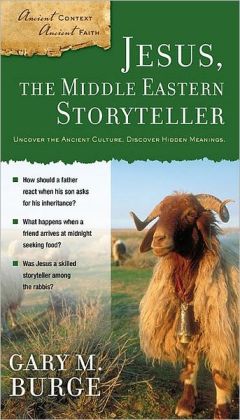
Jesus, the Middle Eastern Storyteller, by Gary M. Burge


Jesus, the Middle Eastern Storyteller, by Gary M. Burge

Genre: Ancient History / Bible Studies

Reason for reading: This year, I'm studying Jesus and the New Testament. This book was loaned to me by Elizabeth, a friend from work. It was given to her by a friend because the author was her professor.

Synopsis: In this short book, Burge guides the reader to interpret Jesus as a storyteller - a teacher who uses allegory and hyperbole to make important points within his own social context. The book is filled with beautiful pictures and several examples of Jesus' use of hyperbole to teach an important point. Burge provides historical and cultural insight into what Jesus may have been talking about when telling his parables. 

My thoughts: I was surprised at how fun this book was. Although it's quite short, and half of it was pictures, it made me look at Jesus from a interesting new perspective. Of course, I already knew that Jesus used parables and hyperbole to make points, but it was really interesting to read Burge's cultural analysis of those parables. 

The story I found most enlightening was Burge's interpretation of the fig tree incident. For those of you who don't recall, the story is related in Mark 11:12-14, 11:20-25; and in Matthew 21:18-22. In my unromantic version, Jesus is hungry, and he sees a fig tree by the road. It's not fig season, so the tree isn't bearing any fruit. Jesus curses the poor tree and it withers. I've always disliked that story. Despite my cousin Steve's insistence that fig trees don't have feelings, and I shouldn't take the story so literally, I always felt sorry for the tree. Why'd Jesus curse a tree just because it wasn't bearing fruit in the off-season? (And, yes, Mark clearly states that it wasn't the season for figs.) 

Burge pointed out that the fig tree represented the Jewish state and religion. Throughout the New Testament Jesus repeatedly pointed out the hypocrisy of the Pharisees, who made a public spectacle of themselves fasting, praying, and giving alms; but who did not keep the spirit of religion in their hearts. They prayed for the approval of the people, not for the approval of God. Thus, they were not "bearing fruit." 

Of course, I realize that this insight about the fig tree and the Pharisees is not uniquely Burge's - in fact I found some interesting articles on the subject after reading Burge's book (here's a good one). What's important is that Jesus, the Middle Eastern Storyteller introduced me to some interesting interpretations that I could look into in more detail later. In that way, this book was a valuable resource for me.


Thursday, July 12, 2012

Abraham, by Bruce Feiler


2012 Book 105: Abraham: A Journey to the Heart of Three Faiths, by Bruce Feiler (7/11/2012)

Reason for Reading: It fit into Reading Globally's Middle Eastern literature theme. 

My Review 3.5 stars
In this short work, Feiler reviews the Biblical story of Abraham and then describes how the myth of Abraham has changed over time and between the Abrahamic religions. It is well-written and interesting, and its length is well-suited for the amount of information Feiler wishes to convey. (There were no lengthy speculations in order to add bulk!) I enjoyed it and learned a little bit, too!

Sunday, July 1, 2012

The Bronze Bow, by Elizabeth George Speare


2012 Book 98: The Bronze Bow, by Elizabeth George Speare (6/30/2012)

Reason for Reading: I'm participating in the Middle Eastern literature theme read, and this book fits the theme because it takes place in Israel; however, I'm not sure they're really interested in children's literature, so this was really for my own edification.

My Review 5/5 stars
Daniel has been living for years as a member of a band of Zealots who wish to free the Israelis from Roman oppression. When he meets a preacher named Jesus, he realizes that perhaps his path of violence and thievery isn't quite as logical as he'd thought it was. This is a fun book for kids, with adventure, interesting moral lessons, and new friendships. Although Jesus is a character in the book, he is only a minor one--the book is mainly historical fiction, and I think the lessons Daniel learns (violence, thievery, and hatred don't accomplish anything good) are appropriate for kids of all religions or lack thereof. This is a must-read.

A controversial side-note: This book has been banned from many public school library on the following charges: 1) It's too Christian, 2) It promotes bigotry against Jews, and 3) It suggests that Christianity is "right" and Judaism is "wrong." I thought I'd address these issues. 

1)Too Christian: Kids are intelligent, we need to have more faith in them. They are not going to convert to Christianity just because they read one Christian fiction book. This book isn't even Christian fiction, though it does get close. Kids will be better people in the end if they are introduced to all world religions, as well as many different cultural ways of looking at the world...it will make them LESS racist and more empathetic towards people with different beliefs. 

2) Hostile towards Jews: I'm not sure how? I've read a few arguments on this subject, and the people who claim that it promotes bigotry or that it is hostile towards Jews don't provide examples. Or, when they do provide examples, they quote the book out of context to such extremes that it seems purposeful. But I'm going to assume that SOMEONE (who is actually honest) must have been insulted by this book at some point? I see only two reasons why that would be. 

First, the characters in the book are mostly Zealots who are angry about the oppressive Roman regime. It could be perceived as portraying Jews as angry or racist. However, the book did a good job of showing that this anger is rightfully aimed at an oppressive regime. People under oppressive regimes get angry. That's a fact. So this book is both sociologically and historically accurate when it portrays some of its characters this way. Furthermore, the book is very sympathetic towards the characters and is rather more hostile towards Romans than Jews.

Second, there was a very short (maybe 3 sentence) passage in which it said that the priests from the synagogue were angry at Jesus and might try to get him killed. I understand that this pokes at the let's-blame-the-Jews-for-the-death-of-Jesus wound that is still open and festering among some Jewish people (and some Christians???). I'm truly sorry about this open festering wound, but the passage in The Bronze Bow was very short and there's no way it will encourage kids to blame currently living Jews for the death of Jesus. 

I grew up hearing these stories for my entire life, and I never realized this was an open, festering wound until I was 23 and talking to a rather onerous Israeli friend who (for reason still unknown to me) was trying to start an argument. He said to me: "You should hate me because, after all, I'm Jewish and we killed Jesus." I was completely floored by this comment because the idea of blaming the Jews for Jesus' death was foreign to me. I answered "But the Romans killed Jesus." I had a Catholic education, heard all the stories from the Bible and still never considered the idea that Jewish people alive today could be blamed for the death of Jesus. It seemed preposterous. As far as I was concerned, Jesus was killed by Romans for political reasons that I didn't quite understand. Though I know now that this is not just an issue with my Israeli friend...I came across the same idea in the book The Faith Club. 

I think that books like this with very short passages that reference well-known stories out of the New Testament aren't going to encourage kids to be bigoted. It's bigoted parents, teachers, and role models that will encourage kids to be bigots, not The Bronze Bow.

3) Christianity is right, Judaism is wrong: Well, it DOES imply that Christianity is right. That doesn't mean that it implies Judaism is wrong. It never says that anywhere. There are scenes when the kids break rules, like washing hands before eating...but if kids breaking rules proves that they're right to do so, then the Harry Potter books imply that kids are "right" and schools are "wrong."

Sunday, June 17, 2012

Revelations, by Elaine Pagels


2012 Book 85: Revelations: Visions, Prophecy, and Politics in the Book of Revelation, by Elaine Pagels (6/17/2012)

Reason for Reading: General interest in Church history and apocalyptic literature

My Review: 4/5 stars
In her newest book, Pagels explores the history of John of Patmos' Book of Revelation. She outlines what we know about John of Patmos, what he was trying to say with his preaching, and how contemporaries may have responded. The second half of the book covers the history of Christianity in the first two centuries C.E., with emphasis on Pagels' favorite topic of disparate beliefs among early groups. She completes the book with a description of how the Bible Cannon was chosen, with some suggestions about why John of Patmos' Book of Revelation was the only apocalyptic literature included. Pagels' writing is clear and interesting, though a bit repetitive--especially if you've read some of her earlier works. If you're interested in early church history, especially the disparate groups of Christians, then this is the book for you. If you're interested in apocalyptic literature in early Christian history, then the first half of this book, and the tail end, is for you.