Showing posts with label Classics. Show all posts

Tuesday, March 18, 2014

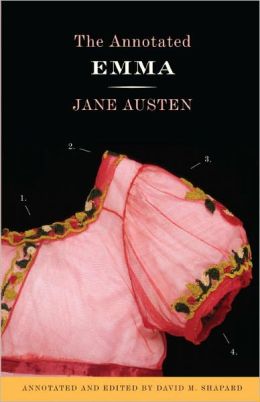
The Annotated Emma, by Jane Austen


The Annotated Emma, by Jane Austen

Genre: Classic / Regency Romance

Reason for Reading: I'm rereading all of Austen's novels. I've seen these Annotated versions and been tempted to try them out for a while, and this is the one I ended up picking up. 

Synopsis: Emma is young, rich, beautiful, and the most important gentleman's daughter in her neighborhood. When her governess marries and moves away, Emma must find another friend to entertain herself. She chooses Harriet Smith, the love-child of nobody-knows-whom, and boarder at a local country school for girls. Emma, well-meaning but naively self-important, makes a mess by foisting potential suitors upon poor Harriet, while Emma's old friend Mr. Knightly tries in vain to check Emma's eager naivete. 

My thoughts: I'm a huge fan of Jane Austen. This is the third time I've read this novel, and I've seen all the movie renditions multiple times. I love watching Emma grow in wisdom throughout the story. And her romance is, in my opinion, the sweetest of those written by Austen. But I recognize that this is a difficult book for many people to get into because of Emma's painful flaws and poor choices. Another reason that Emma is less appealing to some readers is because the narrator's perspective is so unique. The POV focuses almost entirely on Emma's perception of the world, to the point where it is easy to be mislead about what is really occurring since we are only seeing what Emma sees. Emma, especially at the beginning of the novel, tends to be very self-centered and aloof, and so is the narration of the novel. However, even though this POV makes the story harder to get into than the other Austen novels, this is Austen's most appealing work for character study.  

The annotations of this book are lengthy and detailed. Many interesting images and comments are included so that we can visualize antique customs, fashions, and furniture that Austen's readers would take for granted. That aspect of the annotations was fantastic. The annotations also included a lot of character analysis commentary, such as "Emma thinks such-and-such is happening, which shows you how much she lacks self-awareness at this stage." These annotations included a lot of spoilers (the reader is warned which annotations include spoilers, but sometimes these warnings were dropped out of the ebook version - so caution should  be practiced if you're reading the book for the first time and you have ebook format). These character analysis annotations were sometimes interesting, but mostly they told me things I'd already knew - either because I was familiar with the story or because I am sensitive to Austen's nuances. Therefore, I think this annotated version is for you if 1)You are interested in having some historical perspective, 2)You are reading the book for the first time and don't mind spoilers, 3)You're re-reading the book, but don't remember the details and nuances, and/or 4)You just love reading annotations. In other words, I am glad that I read this one book from The Annotated Austen series, because I enjoyed the historical perspective notes, but I probably will not pick up any of the others because I think I got the main idea now. 


Monday, June 3, 2013

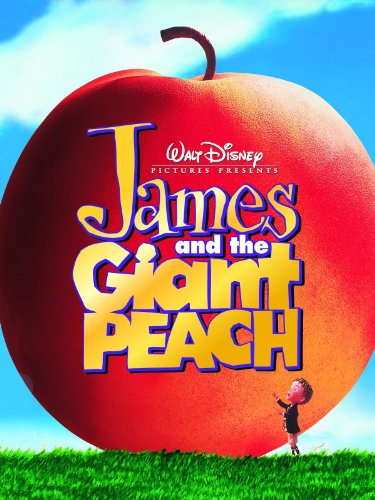
James and the Giant Peach, by Roald Dahl

James and the Giant Peach, by Roald Dahl

Reason for Reading: To keep up with my nephew's book reports

Genre: Children's Adventure / Fantasy

Review
After the tragic death of his parents, James has been living with his horrible neglectful, hateful aunts Sponge and Spiker. One day James is given a magical bag by a mysterious stranger - and in his excitement he trips on the root of a peach tree and dumps all the magic on the tree. Soon a peach larger than a house has grown out of the tree. James crawls into the peach and begins the adventure of a life-time. 

This is another classic kids story that I read as a child and haven't picked up since. I'm glad I had a reason to pick it up again, because it was really funny and silly and it had a lot of nostalgia for me. Dahl has just the right amount of humor and whimsy in his books. :)


After reading the book, my nephew and I watched the 1996 stop-action movie. It was a cute movie that followed the basic story-line well enough. But it was a bit too sentimental and it lacked the dark humor of Roald Dahl's story. Cute for an hour's entertainment, but nothing I'm going to watch again and again. 
 

Friday, May 24, 2013

Charlie and the Chocolate Factory, by Roald Dahl


Written by Roald Dahl and Narrated by Eric Idle

Reason for Reading: I'd watched the two movies with my nephew, who'd just read the book, and I decided that I wanted to know which one was more true to the book. 

Genre: Children's Fantasy / Humor / Adventure

Review
When Willie Wonka announces that he's hidden 5 golden tickets to his fantasticly famous, but very mysterious, chocolate factory, Charlie Bucket wishes more than anything that he could be one of the lucky 5 winners. But Charlie is very poor and can not afford to buy any of the chocolate bars that conceal the tickets. Luck knocks unexpectedly, though, and he's up for the adventure of a life-time with 4 other kids - each of whom has at least one huge personality flaw. Violet Beauregarde is uber-competitive and has a nasty chewing-gum habit, Veruca Salt is spoiled rotten, Mike Teavee is a know-it-all who watches too much TV, and Augustus Gloop is grossly overweight and incredibly greedy. As the eccentric Willie Wonka takes the kids on a wild tour of his factory, each of the kids suffers dire consequences of their flaws. 

This is my FAVORITE Roald Dahl book. Hilarious and fun - and it has a classic movie that makes me even fonder of it. :) I really enjoyed listening to Idle's fantastic narration of the story - though I wish he'd sung the Oompa Loompa songs instead of just reading them. But no one's perfect. :) I think I enjoyed this book just as much as an adult as I had as a child. 

My nephew and I compared the two film adaptations. The first was the Gene Wilder version from 1971 and the second was the Johnny Depp version from 2005. I hadn't seen the classic movie for many years, but I had watched the newer one when it came out. I remember being disappointed in the newer version, but this time around I rather enjoyed it. Yes. It was different than the classic movie, but they were both very interesting interpretations. They both took some artistic license - and each had some stronger points and weaker points. The 1971 version, of course, inserted all that stuff about Arthur Slugworth (not to be confused with Horace Slughorn) and the 2005 version inserted all that stuff about Wonka's father. Other than that, there were only minor tweaks to the story in either one, and I was surprised to realize that they both were equally true to the book, in their own way.


So, who's my favorite Willie Wonka? I don't know! That's really hard to decide. The character was acted QUITE well both by Wilder and by Depp, though in very different ways. Wilder's was eccentric in a crazy-scary sort of way. Depp was eccentric in a wacky-vulnerable-creepy sort of way. These were very different interpretations  but I was surprised to realize that they were more similar to each other in some ways than they were to the book character (as read by Idle). Both of Depp and Wilder (especially Wilder) seemed almost to encourage the nasty little kids to misbehave. Willie Wonka of the book seemed mostly unconcerned with the consequences of misbehavior, but seemed to genuinely warn them not to misbehave. 


Charlie Bucket was cute in both movies, and the interpretations of the actors was fairly similar. I think Peter Gardner, of the 1971 version, sparkled just a tab bit more. Look at that cute expression when he finds the ticket. :)


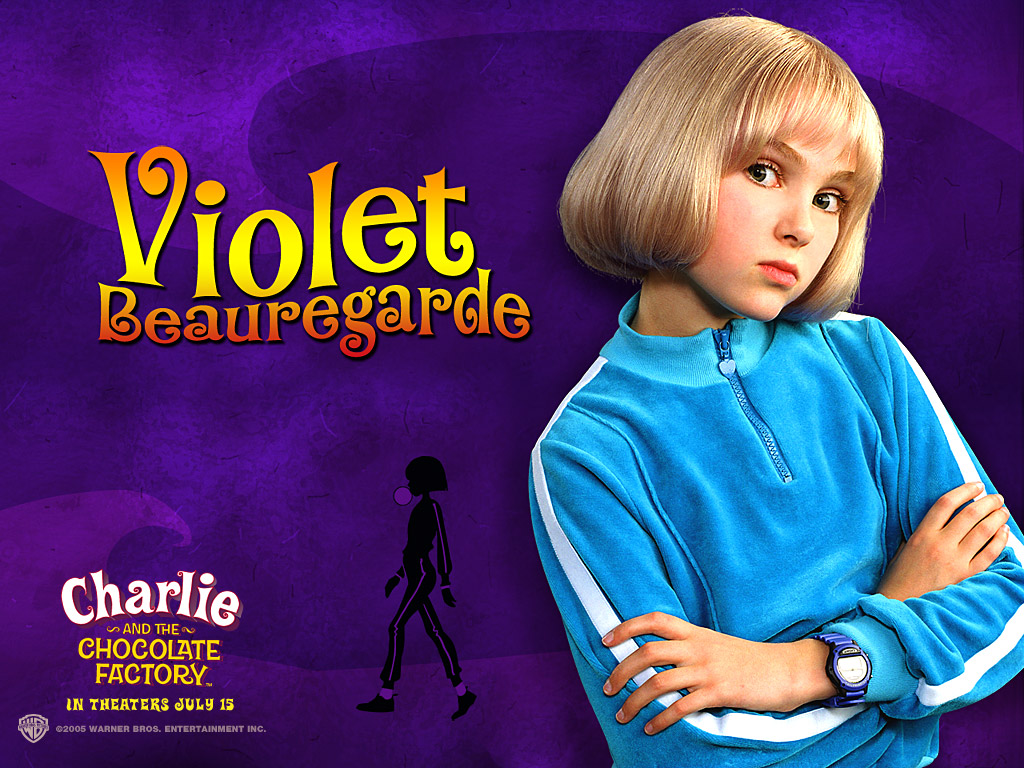
Violet Beauregarde was modernized in the 2005 version. She was still the over-competitive gum-chewing brat written by Dahl, but she was the daughter of a win-or-die beauty queen and was totally kick-butt in a losing-isn't-an-option-because-you're-better-than-them sort of way. Basically, it's making fun of a certain stereotype of over-competitive girls that didn't exist when Dahl wrote the book. So, the Violet of the 1971 version was more true to the kid in the book, but  I could better relate to the stereotype portrayed in the 2005 version - and I think this modernization was spot-on with the message Dahl portrayed in his book.


Veruca Salt was cuter in the 2005 version, but she had SO much more attitude in the 1971 version. Look at that "I want it NOW!" face. Definitely a bad egg.


Mike Teavee was obnoxious in both versions. He was modernized a bit in the 2005 version - he was addicted to video games rather than TV - but their interpretations of the character were pretty similar and I don't see any reason to think one did a better job than the other.


The first thing my nephew said when he saw Augustus Gloop in the 2005 version is "he's even fatter in this one!" Indeed, the only character trait Augustus had in the 2005 version is that he was severely obese. To the point of it being a little too much, I feel. Augustus Gloop in the 1971 version is quite fat enough to get the point across, and he has a lot more personality. 

Which movie did you like better, and why?


Monday, January 28, 2013

The Last Unicorn, by Peter S. Beagle

The Last Unicorn, by Peter S. Beagle

Reason for Reading: Group read on LibraryThing's Green Dragon 

Review
When a unicorn realizes that she may be the last remaining unicorn, she leaves her peaceful home on a quest to find out what happened to all her brothers and sisters. Along the way, she picks up bumbling magician seeking his talent and a dour cook looking for her lost innocence. The unicorn soon discovers that the world has changed since she last ventured out. Humans have lost their youthful innocence, and they are no longer able to see things as they truly are - humans have excelled in the art of deceiving themselves. 

When I originally picked up this book, I'd expected a cute young adult tale, but never expected such depth. The Last Unicorn is a multi-layered allegory: about lost innocence, self-fulfilling prophecies, and self-deception. But these cynical themes aren't the main point. The main point is that only in fully understanding humans can the ethereal unicorns save themselves. Only by sacrificing a piece of their ineffable essence can they form a closer bond to humans. And this closer bond can lead humans to do wonderful things. 

Yes, it is a Christian allegory by my interpretation. But I think it's amazing the way Beagle didn't just throw in a Christ Figure and be done with it....The allegory of Beagle's unicorn isn't uniquely Christian - it defies religious boundaries. It is a story of love and innocence that mixes cynicism and hope. Quite extraordinary! :)

I was also a HUGE fan of the bumbling wizard Schmendrick who (in my opinion) was only fooling himself into believing he wasn't a capable wizard. He's like the Lion, the Scarecrow, and the Tin Man in Wizard of Oz - just the fact that he wanted so badly to be a wizard made him into one. He could laugh at all the people who deceived themselves, as he unconsciously deceived his own self. He reminded me of myself when I'm in a glum mood thinking I'm not capable of anything when, of course, I'm quite capable if I'd stop expecting so little of myself. ;) This book was a good reminder to have faith in yourself and think about the consequences of your beliefs. :)

Friday, January 25, 2013

The Princess and the Goblin, by George MacDonald

The Princess and the Goblin, by George MacDonald

Reason for Reading: Group read with Simpler Pastimes

Review
This classic fairy-tale-style story is set in a land where the Goblins and Humans have had a "cold war" for many, many years. Long ago, the Goblins threatened that some day they will steal a princess...and their day finally comes when Princess Irene's nurse accidentally keeps the Princess out after sunset. Luckily, they are rescued by a miner's boy, Curdie - but now the Goblins know where the Princess lives and what she looks like. When the Goblins hatch a devious plot, Curdie and Irene become fast-friends as they act in turn as heroes. First and foremost, this is a fairy-tale. But it is also an allegory about faith. Princess Irene has a great-great-grandmother - a mysterious and heavenly woman that only she can see. Irene's very-great grandmother gives the Princess a magical string and tells her to follow the string whenever she's afraid - never doubting it or deviating from it, regardless of where it may take her. Irene must learn to have faith even when she thinks that the string has led her astray. And Curdie must learn to have faith in a very-great grandmother that he has never seen.  This is a sweet story, nice for reading aloud to young children. 

Tuesday, January 15, 2013

Sense and Sensibility, by Jane Austen

Sense and Sensibility, by Jane Austen

Reason for Reading: Well, actually, it was an accident. I watched the BBC movie with my mom and she asked me how similar it was to the book. I said that it was very close to the book, but that there were a few things in the movie that I didn't really believe happened that way in the book. So I picked up the book and started reading. Got sucked in. :) I was wrong, though, all three incidents happened in the book. 

Review
This is the story of two very different sisters: Elinor is a sensible (yet secretly passionate) young woman who must continuously reign in the wild passions of her mother and sisters - especially Marianne whose head is filled with romantic notions of one-true-love and tragedy. When their father suddenly dies with their newly-acquired estate entailed away to their half-brother John, the sisters are left destitute. John and his wife Fanny descend upon the mourning family within a fortnight and make the sisters and mother feel like unwelcome guests in their beloved home. Elinor soon forms an attachment with Fanny's brother Edward, but Fanny doesn't approve of Elinor's lack-of-fortune-or-name. So the family moves away to a cottage, leaving Edward behind. Poor Elinor must struggle with her own worries about Edward while at the same time monitoring the expensive of the house and trying to reign in the wild, all-consuming attachment of Marianne to the dashing young Willoughby. The romantic hopes of both girls spiral downwards as more and more obstacles appear. 

I love this story because I've always admired Elinor for both her passion and her ability to handle all problems that come her way. I also admire Colonel Brandon for his devotion to Marianne despite her ecstatic preference for the younger, handsomer, and less reserved Willoughby. This time around, I also really appreciated Marianne's character. Her youthful ideas about love were cute - and realistic for many girls of 16. :) Her development throughout the story was extraordinary. I loved the way she slowly, cluelessly, began to understand the world around her. I don't admire her, but I think she's cute and very funny. And, frankly, a more interesting character than Elinor (due to her development-of-character).

To be honest, this book is just as much a favorite as Pride and Prejudice. Yes. That is right. I ADMIT that I like this book just as much (possibly a little more) than the beloved P&P.

Thursday, January 10, 2013

Hamlet, Act III


Act III is the pivotal act in Hamlet. The Prince had been dragging his feet for months trying to force himself to avenge his father's death. At one time, he'd be certain that the ghost was truly the restless spirit of his father seeking revenge; another time he'd fret that the ghost may be a demon sent to tempt the Prince into a fatal and condemning act. In scene i, he had his famous "get thee to a nunnery" fight with Ophelia. Frustrated with his own impotence, he extended the blame of his mother's inconstancy to all women. Maddened at the thought of Ophelia's future marriage to someone else; maddened at what he saw as her certain inconstancy in the future, he demanded that she commit herself to a convent. His interaction with Ophelia was observed by Polonius and Claudius, who decided that he was dangerously addled and must be sent away to England (presumably with hopes that the distraction would clear his mind). 

In scene ii Hamlet made pointed remarks during a play, hoping to draw out Claudius' guilty response. Hamlet succeeded in drawing out Claudius, who angrily retorted at the content of the play and stomped out of the room. In the immediate rush of  fear at Hamlet's knowledge, Claudius suddenly felt his own guilt. He regreted killing his brother - not because it was a treacherous act in itself, but because he had been found out and might suffer consequences. He knelt down and prayed that God help him; he asked forgiveness while simultaneously acknowledging that he's not really sorry that he got the Crown and the Queen, but he was very sorry that Hamlet found out about the murder. The Prince discovered Claudius praying and at first set his mind upon killing the King here (when the royal back is turned). But then Hamlet worried: if he killed Claudius now, while praying, the King's soul would be clean and he would be dispatched to heaven. Hamlet wanted Claudius to be damned, like the late King Hamlet. The prince decided to wait.

In the final scene, Hamlet was summoned to the Queen's chambers, where she tried to talk sense into him. There, Hamlet swelled again into his accusatory rage at the inconstancy of women. Polonius, who had hidden himself behind the curtains upon Hamlet's entry, thought to rescue the Queen from her raving son - but when he called out, the infuriated prince stabbed at the curtains and slayed Polonius. With this act, Hamlet's path of revenge was cemented. He had killed once, he had no choice but to continue with his revenge quickly or fail entirely. Shakespeare punctuated this pivotal act with the ghost of dead King Hamlet - who only the prince can see. Prince Hamlet's shock at the escalation of events and the sudden appearance of the ghost muddled his already maddened state, and he ranted wildly while the terrified Queen tried to calm him. The act ends with Hamlet lugging the body of Polonius off stage.

(TO SEE MORE ABOUT HAMLET GO TO MY MASTER POST)

Hamlet and Ophelia
Hamlet (1996)
Directed by Kenneth Branagh
Act III, Scene i: The King and Polonius decided to observe Hamlet as he interacted with Ophelia. They told Ophelia to linger where she was sure to meet Hamlet, and the two men hid. Before noticing Ophelia, Hamlet was deep in his own meditations. To be or not to be? Apparently, Hamlet was considering suicide. Did he know the King was watching? Or was his doubt genuine? There is no indication that he knew the King was near. Personally, I think Hamlet was genuinely considering suicide. He'd experienced some terrible blows in the last few months - his father died unexpectedly, his mother married her brother-in-law, and Hamlet was being haunted by the ghost of his father who was making shocking demands of the Prince. Hamlet was tortured by a feeling of failure that he hadn't avenged his father, stress at the idea of killing the King, and doubt about the nature and intentions of the ghost. That's enough to make any sane person consider suicide. The sudden appearance of Ophelia reminded him of yet another failure in his life. 

Like Claudius and Polonius, I observed Hamlet very closely in this scene because I wanted to consider the age-old question: was Hamlet mad or was he faking it? I saw no signs of actual insanity, despite Hamlet's nonsensical word-play and his irrational anger at Ophelia. He seemed genuinely enraged at Ophelia's perceived inconstancy, and he blamed her for future inconstancies which she had not yet committed; but sane lovers can also be irrational in this way. 

Another question I pondered during this scene was whether Hamlet meant to imply that Ophelia wasn't a virgin (since Harold Jenkins, the editor of my edition, claims that there is no evidence that Ophelia and Hamlet had any pre-action action). And, frankly, I have to agree with Jenkins. There is a lot of double-meaning innuendo during this scene (and the next), but that doesn't prove that they'd been together. Men are quite capable of innuendo in the company of maidens. That proves nothing in itself. So I leave that one open to interpretation.


The Play
Hamlet (2009) Royal Shakespeare Company
Directed by Gregory Doran
Act III, Scene ii: In this scene, the troupe of traveling actors put on a play which closely resembled the murder of King Hamlet. The Prince made continual jibes and probes at the King until Claudius angrily announced that he'd had enough and stomped out of the room - which was exactly the guilty reaction that Hamlet was hoping for. Now Hamlet could avenge his father's death with confidence that Claudius is guilty.

This scene is scrutinized closely by critics. The play began with a dumbshow which silently portrayed the murder - but Claudius apparently didn't respond to this dumbshow. The King only responded upon seeing the murder in the spoken play. Critics ask the question: did the King see the dumbshow? Why wasn't he offended by it? Why did he wait until the second enactment of murder before retorting? Some directors believe that Claudius didn't see the dumbshow. They have him turned away from it, chatting with a neighbor. Others believe that Claudius saw the dumbshow, and silently blanched, but wasn't truly provoked until Hamlet's comments during the second enactment. Harold Jenkins (forever the literalist) believes that neither of these two things happened, because otherwise it would have been mentioned in the stage directions. :) A sophisticated connoisseur of Hamlet apparently watches Claudius during this scene in hopes of determining which interpretation the director has chosen.


Hamlet almost kills Claudius
Hamlet (2009) Royal Shakespeare Company
Directed by Gregory Doran
Act III, Scene iii: Shocked by the realization that Hamlet knew Claudius' guilt, the King prayed for help from God. Hamlet discovered Claudius praying, and almost killed him there...but then decided that if he killed Claudius when his soul was cleansed by prayer, Claudius would achieve salvation. Hamlet wanted Claudius to be damned, so he waited a better opportunity for revenge.

The question I asked while reading this scene: Was Hamlet just procrastinating, or did he really not kill Claudius in prayer because he wanted to damn Claudius' soul? Personally, I think he was procrastinating. He had resolved that he must kill Claudius, but he didn't have the nerve to do it in cold blood. 

Hamlet in the Queen's Closet
Hamlet (2009) Royal Shakespeare Company
Directed by Gregory Doran


Act III, Scene iv: Hamlet ranted at the Queen in her chambers. Polonius, hidden behind the curtains, moved to assist the Queen, and Hamlet stabbed him. Hamlet seemed rather surprised to discover that he'd killed Polonius. What did he expect? That the King was hidden behind the curtains? Personally, I think he wasn't thinking. He had worked himself up into a frenzy talking to the guilty Queen, and was surprised by Polonius' sudden call. He stabbed the curtain, not knowing what lay behind it, and only afterwards asked "Is it the King?" His confusion at finally having spilled blood - though the wrong person's blood - was compounded by the sudden appearance of the ghost. This is the first scene where Hamlet truly appeared, to me, to have lost his wits. He was acting violently without thought of consequence or purpose. His speech was confused. He was utterly out of his depth. 

Monday, January 7, 2013

Call It Courage, by Armstrong Sperry

Call It Courage, by Armstrong Sperry

Reason for Reading: This book won the Newbery Medal in 1941. It's been sitting on my shelf for years.

Review
Mafatu is afraid of the ocean because he almost drowned when he was a boy. But in his culture, fear is scorned and laughed at. Mafatu feels that he must redeem his good name and prove that he is not afraid anymore. He climbs in a boat and goes on a voyage, but he soon finds himself shipwrecked on an apparently-deserted island. There, he keeps himself alive by making all of his own tools, weapons, and a new canoe. He battles a tiger shark, an octopus, and a boar. He defies the cannibals when they return to their island. But will he be able to return home? This was a cute book, and I enjoyed the adventure - though it's very short and all the adventure is packed in at a very unrealistic pace. Regardless, I really enjoyed the couple of hours I spent with it. I think a young reader might find this book fun. It's appropriate for someone reading at maybe the 3rd grade level. 

Friday, January 4, 2013

The Last Battle, by C. S. Lewis

The Last Battle, by C. S. Lewis

Reason for reading: This is the seventh (and final) book in the Chronicles of Narnia, which I've been reading in order-of-publication. I plan on rereading them all in chronological order using Planet Narnia: The Seven Heavens in the Imagination of C. S. Lewis, by Michael Ward as a guide.

Review
The final book in The Chronicles of Narnia depicts the apocalypse of Narnia. When a shrewd monkey teams up with Calormen to trick the Narnians into thinking Aslan has returned - and they are his spokespeople - Narnia is cut to ruins. Forests are destroyed, Narnians begin to doubt Aslan, and cities fall to heathen invaders. I'm afraid to say this was my least favorite of the Narnia books (though I still liked it quite well!). Intellectually, I know Lewis had to have an apocalypse - whatever begins must also end - but it was still a bit dreary.  So although I understand why the apocalypse had to come, I still liked the other books so much better. Not only because they were much more cheerful, but also because they had more fun-filled adventure.


However, despite my misgivings about uplifting-yet-dreary endings, I want to address Philip Pullman's opinions about the Narnia series (which I first mentioned in my blog post about The Amber Spyglass). WARNING: This commentary will have spoilers for the Narnia series! In his 1998 article in The Guardian, The Darkside of Narnia, Pullman stated his opinion about the Narnia series: “there is no doubt in my mind that it is one of the most ugly and poisonous things I've ever read.”   Pullman is an atheist, and he believes that the being-dead-in-Heaven-is-better-than-being-alive-on-Earth philosophy is "life-hating." It is unsurprising, therefore, that he feels The Last Battle is "one of the most vile moments in the whole of children's literature." Happily, I disagree with his anger at this belief in Heaven. Even though I found The Last Battle to be a bit dreary, I appreciated the message of love and Heavenly gift that Lewis was portraying.

Pullman continues to say:
But that's par for the course. Death is better than life; boys are better than girls; light-coloured people are better than dark-coloured people; and so on. There is no shortage of such nauseating drivel in Narnia, if you can face it.  
I agree that Narnia conveys some rather sexist and ethnocentric views, but that's what English literature of that period was like. Lewis (and the Narnia books) are a product of their time.

I don't think any of those arguments is strong enough to merit my discussion alone. The reason I felt moved to discuss Pullman's opinions are in this paragraph (which I unfortunately read before completing the series):

And in The Last Battle, notoriously, there's the turning away of Susan from the Stable (which stands for salvation) because "She's interested in nothing nowadays except nylons and lipstick and invitations. She always was a jolly sight too keen on being grown-up." In other words, Susan, like Cinderella, is undergoing a transition from one phase of her life to another. Lewis didn't approve of that. He didn't like women in general, or sexuality at all, at least at the stage in his life when he wrote the Narnia books. He was frightened and appalled at the notion of wanting to grow up. Susan, who did want to grow up, and who might have been the most interesting character in the whole cycle if she'd been allowed to, is a Cinderella in a story where the Ugly Sisters win.  
When I read this paragraph, I wondered what Lewis actually did do with Susan in the book. But when I read the book, I interpreted those events differently than Pullman: Susan wasn't allowed into Heaven at that time. It was made clear that Susan was in one of the silly stages of life, but it was just a stage. She still had a chance to grow out of it. She hadn't been rejected from Heaven permanently, and it wasn't her time to die. Susan lived. And Susan had the ability to change (just as Pullman points out). Lewis wasn't saying that grown-ups can't go to Heaven. After all, the kids' parents went to Heaven, didn't they? Lewis was saying that Susan was in a phase where she idolized material things - and had thus turned away from her spiritual health.

Also, I'm not certain Susan really is the most interesting character. By Pullman's definition (he-who-changes-is-most-interesting) I believe Eustace's character developed much more than Susan's character. Why is Pullman ignoring Eustace?

What do other people think about Susan's character? Do you think Lewis meant for her to be denied Heaven permanently?

Tuesday, January 1, 2013

The Magician's Nephew, by C. S. Lewis

The Magician's Nephew, by C. S. Lewis

Reason for Reading: I'm finishing up the Narnia chronicles in order-of-publication. This is the penultimate book. :) I chose to read this book NOW because of the Classics Children's Literature Challenge.

Review
When Digory's evil magician uncle tricks Polly into entering another world,   Digory must rescue her. Their adventure heightens when they discover an evil witch and then witness the creation of Narnia. This is the first time I've read this adorable classic. I've heard it was the book that Lewis meant to start the series with, but it was so difficult to write that he put it off until he had developed Narnia a bit more. It's probably good that he did, because I enjoyed seeing references to the earlier books...like the story of how the light-post ended up in the middle of a forest in Narnia. :) I look forward to re-reading this book later (this year?) when I read them in chronological order. :D

Monday, December 31, 2012

Old Curiosity Shop, by Charles Dickens

The Old Curiosity Shop, 

Written by Charles Dickens, Narrated by George Hagan

Reason for Reading: I'm making a point of reading all of Dickens' major works. This month, Caroline from Beauty is a Sleeping Cat and Delia from Postcards from Asia hosted Dickens in December, a month dedicated to Charles Dickens. This will also count for the 7th completed book in my Classics Club list

Review 
When Little Nell's grandfather drives himself into gambling debt (in hopes of raising money for Nell's future), they must take to the streets to escape the malicious designs of more than one nasty character. Nell's grandfather increasingly becomes a doddering old fool, and Nell is left to her own devices in finding refuge from the cold, the hunger, and the devious people-of-the-streets. Unbeknownst to them, their good friend (and former servant) Kit is desperately looking for them - praying for their safety and not knowing why they have left. I think this is my least favorite Dickens book so far. Generally, I am able to get involved in the complex narrative and the variety of character in a Dickens novel, but kit was the only character I really cared much about. Nell and her grandfather were so melodramatically pathetic that, although I felt sorry for their situation, I couldn't get myself to really care about the outcome. Perhaps this was just timing - maybe I'd have liked the book better in another mood. But I can't say I'll ever try reading it again to find out. Not a bad book - but Dickens can do better.


Saturday, December 22, 2012

A Christmas Carol, by Charles Dickens

2012 Book 172: A Christmas Carol

Written by Charles Dickens, Narrated by Tim Curry

Reason for Reading: I read this for a Dickens in December readalong hosted by Beauty is a Sleeping Cat and Postcards from Asia. Unfortunately, I'm a day behind on my post! This is also one of the 1001 Books You Must Read Before You Die (sign-up for Team 1001 here).

Review (contains spoilers :p)
When grumpy and miserly Ebeneezer Scrooge is visited by the ghost of his long-deceased business partner, he gets the shock of his life. Apparently, a person's job on earth is to walk among his fellow men and help them. For those who were too selfish to help during life, they are doomed to an eternity of walking among men while desiring to help, but not being able to. Scrooge is about to be given a chance at redemption. He will be visited by three ghosts. The Ghost of Christmas Past will remind him that although he'd had a rather dreary childhood, he'd had plenty of chances to make people (rather than wealth) his passion. The Ghost of Christmas Present will show him how happy people can be when they are surrounded by the people they love at Christmas. And the Ghost of Christmas Future will reveal a dreary future which may come to pass if Scrooge continues on his miserly path. On Christmas morning, Scrooge will awaken a new man - someone who knows how important it is to love one's neighbors and to rejoice in their friendship. This is such a great story because it reminds us that wealth does not necessarily make us happy. It reminds us to look at the world through a different perspective. And, it's pretty darned funny. :) 

This well-known story was excellently narrated by Tim Curry...and I'm SO glad I decided to pay the extra couple of dollars for the Curry narration! His voice is soothing yet engaging at the same time. His voices for each character are spot on. And his delivery of the humor was so well-timed! 


Monday, December 17, 2012

Three Men in a Boat, by Jerome K. Jerome

2012 Book 168: Three Men in a Boat (To Say Nothing of the Dog)

Written by Jerome K. Jerome, Narrated by Frederick Davidson

Reason for Reading: This was my "monthly random pick" which took me two months to get to. :) My next "monthly random pick" is The Passage, by Justin Cronin. This book is a classic, so it fits in my Classics Club list. :) 

Review
In this classic novel of humor, three men (to say nothing of the dog) decide to cure their hypochondriac ailments by getting fresh air and exercise. They decide to travel down the Thames in a boat. The narrator jumps back and forth between humorous description of their preparations/trip and silly reminiscences of loosely connected incidents about the characters. This is the type of book where, at the end, you're not sure if there was any story in there at all, but you certainly enjoyed the trip regardless. It was a good-natured, happy sort of humor. This is a short book, and certainly worth reading if you like the classics. :)


Sunday, December 2, 2012

Hamlet Act II

Rosencrantz and Guildenstern
Rosencrantz and Guildenstern are Dead (1990)
Directed by Tom Stoppard
Clearly some time has passed since the first act. Enough time that Ophelia has been able to rebuff Hamlet's attentions, for Hamlet to "go insane," and for his royal parents to send off for Rosencrantz and Guildenstern to come from abroad. Maybe a few weeks? A couple months? Hamlet still hasn't done anything to avenge his father's death, and he's starting to feel worthless. He's not quite sure whether his father's ghost is a demon sent to tempt Hamlet into a wrongful act, but he feels like he ought to believe the ghost's story. And he ought to have acted on it. When the troupe of actors arrives, Hamlet thinks this is his chance to throw a wrench in Claudius' gears - to make him betray his guilty conscience in an unguarded moment. Hamlet admonishes himself for his weakness - he ought to act on his vengeful instincts, but he lacks the courage. 

Some questions that I'm thinking about while reading this: 

First, I wanted to see for myself whether I thought Ophelia was a virgin or not. (Remember in my notes on the introduction by Harold Jenkins I said that Jenkins believed Ophelia died a virgin.) During Hamlet's discussion with Polonius, Hamlet first compares Polonius to a fishmonger. According to Jenkins, the daughters of fishmongers are seen as having more than ordinary propensity to breed. Hamlet then says: "Let her not walk i'th' sun. Conception is a blessing, / but as your daughter may conceive - friend, look to't." Now, outwardly, Hamlet referred "conception" to the breeding of maggots under the sun (from an earlier line), but how can there be any question that Hamlet meant also to suggest that Ophelia might conceive a child? But does Hamlet mean "Don't let her out, or something bad might happen to her." Or does he mean "Don't let her out, because everyone will soon be able to see she's pregnant." I guess that's open to interpretation. Later in the scene, Hamlet compares Polonius to the Hebrew judge Jephthah, who sacrificed his virgin daughter. That might be a hint that she's still a virgin, and that Polonius is endangering her.

My second question was whether Hamlet is feigning madness or was really mad. I can see why many people believe he was only feigning madness - his "mad" ranting during this act was calculated to mock Polonius, Rosencrantz, and Guildenstern. There was a method to his madness. :) But, as far as I'm concerned, the phrase "fake it till you make it" applies in Hamlet's case. He certainly had enough to go mad over...

(TO SEE MORE ABOUT HAMLET GO TO MY MASTER POST)

Polonius and Reynaldo
The Royal Shakespeare Production 2009
Directed by Gregory Doran
Act II, Scene i: The act starts with Polonius instructing his man Reynaldo to spy on Laertes. A very untrusting father, is Polonius. As soon as that important business is through, Ophelia dashes in to tell her father about a shocking encounter with Hamlet. The prince has apparently entered her chamber uninvited, grabbed Ophelia by the arm and creepily stared at her. Then he turned and left the room - eyes cast over his shoulder to gaze fixedly upon the distraught maiden. Polonius gets excited...not only has he discovered the reason for Hamlet's madness (which the King and Queen want to know), but he now has the opportunity to say "Look! I did everything I could to discourage this mis-match, but the Prince is still in love with my daughter...perhaps they ought to marry?" *gleeful aspirations shine in eyes*

Rosencrantz and Guildenstern 
Rosencrantz and Guildenstern are Dead (1990)
Directed by Tom Stoppard
Act II, Scene ii: Hamlet's friends Rosencrantz and Guildenstern have arrived in from abroad, and Claudius and Gertrude are asking them to check on Hamlet - to discover the reasons for his madness and perhaps soothe the melancholy prince. When they leave in search of Hamlet, Polonius comes with their messengers, newly arrived from Norway. The messengers tell Claudius that Fortinbras' uncle has admonished the prince for threatening war with Denmark, but upon Fortinbras' apology, his uncle has furnished the prince with more money for his army and told him to attack Poland instead. They now ask Claudius' permission for Fortinbras' army to cross through Denmark on the way to Poland.


Hmmm. Does someone smell a ploy? They're just going to allow Fortinbras' army to cross through Denmark? Oh well, it's their kingdom. 

After the messengers have been thanked and sent away, Polonius tells the royal couple that Hamlet has gone mad with love for Ophelia. They decide to test this theory later by setting Ophelia loose on Hamlet. (Poor Ophelia.) Then Hamlet walks in. Polonius has a rather nonsensical conversation with Hamlet, partly because Polonius isn't very clever and partly because Hamlet is playing with Polonius' mind. Rosencrantz and Guildenstern walk in. The nonsensical conversation continues with them (and for the same reasons). *Why do Claudius and Gertrude keep sicing idiots on Hamlet? What do they hope to achieve?* Finally, a troupe of actors arrives, and Hamlet decides to use them as bait for Claudius' guilty conscience.

Saturday, December 1, 2012

Hamlet, Act I

In the first act of Shakespeare's Hamlet, the scene is set. We meet the mournful young prince Hamlet who feels wronged by his mother's hasty marriage to her deceased husband's brother...and by their incessant partying in a time of sorrow. We meet Ophelia, admired by Hamlet, her brother Laertes and father Polonius. Finally, we are handed a juicy bit of gossip (adultery and murder!), which give Hamlet his excuse to vent his rage against the tyrant King Claudius. (For a more detailed summary, look below.)

This is my first time reading Hamlet since I was in high school, and I'm looking at it through very different eyes this time around. For instance, I've always been under the impression that Polonius was ridiculous. But this time, he appeared long-winded, but his advice seemed sound enough. Is he really ridiculous, or just verbose? I was gratified upon reading Harold Jenkins' endnotes, where he suggests that Polonius was not meant to be ridiculous but paternal. Emphasizing Polonius' fatherly relationship develops Laertes' role as an avenger against Hamlet later in the play. 

A phrase that jumped out at me on this reading was when the ghost told Hamlet (I.v): "Taint not thy mind nor let thy soul contrive against thy mother aught." Interesting. Because I recall Hamlet being very lusty in his anger against the Queen later in the play. Do I remember wrongly? Or is Hamlet disobeying the ghost? I will have to read on and see. Also, what did the ghost mean by "taint not thy mind"? Was the it admonishing Hamlet to keep his mind clear? Because Hamlet either feigns madness or actually goes mad later in the play. Again, did Hamlet disobey the ghost? 

The final thing that struck me in Act I was the questionable nature of the ghost. If Horatio (a clear-headed scholar) hadn't believed in the ghost, I would suspect that Hamlet had hallucinated it in a fit of psychotic rage. Hamlet does incoherently rant during the scenes with the ghost. In his endnotes, Harold Jenkins suggests another alternative - perhaps Shakespeare meant the ghost to be a devil - an evil apparition sent to drive young Hamlet to vengeful madness. After all, the ghost has gone below stage, which represents Hell in classical theater. In a later scene (II.ii), Hamlet even questions the nature of the ghost: "The spirit that I have seen May be a devil." However, based on all the swearing which closes Act I, Hamlet does seem to believe the ghost's story, even if the ghost's nature is questionable.

Perhaps I'll be able to answer these questions as I read on...

(TO SEE MY OTHER POSTS ABOUT HAMLET, GO TO MY MASTER POST)


Claudius and Gertrude
Kenneth Branagh's 1996 film

Act I, Scene ii: Only months after King Hamlet's death, his brother Claudius has married the Queen, and wrested the throne Denmark. Claudius scolds Hamlet mourning the  dead King and then leaves to continue reveling in his new-found power. Left behind, Hamlet bemoans the disgraceful marriage...How could his mother have married so quickly? And to such a man?! Horatio then rushes in to tell Hamlet about the king's ghost. Hamlet decides that he MUST see this for himself.


Ophelia, Laertes, and Polonius
The Royal Shakespeare Production 2009
Directed by Gregory Doran
Act I, Scene iii: Ophelia believes that Hamlet loves her, but her brother Laertes and her father Polonius both caution her against the young prince. Laertes believes that Hamlet, as heir to the throne, will not choose Ophelia for future Queen. Polonius agrees. "Hamlet is young!" he says. "Don't set your heart on him." Despite her assertions that Hamlet is courting her in a gentlemanly manner, Ophelia agrees to be cautious. After a long-winded speech from Polonius, Laertes departs for France.


Plate XLIV from Volume II
of 
Boydell's Shakespeare Prints
Image taken from Emory's Shakespeare Illustrated
Act I, Scene iv and v: It's night, and Hamlet, Horatio, and Marcellus are looking for the ghost. When the apparition appears, it beckons Hamlet to follow. Hamlet desperately tries to follow, while his friends hold him back. Finally, he orders them to let him be.

Once alone, the ghost demands that Hamlet avenge his death. But it admonishes: "Taint not thy mind nor let thy soul contrive against thy mother aught." Hamlet swears to avenge his father's death, and then forces Horatio and Marcellus swear an oath of silence.

Tuesday, November 13, 2012

The Nose, by Nikolai Gogol


Major Kovalev, a Caucus-made collegiate assessor (in other words, a minor official who has been elevated by his connections rather than his intelligence), awakens on March 25th to discover that his nose is missing. To his dismay, he later sees his nose masquarading around town in the guise of a state councilor (equivalent rank of general). Kovalev absurdly tries to put his nose in its place.

Nikolai Gogol's "The Nose" is a satirical short story written around 1835. It is one of Gogol's well-known Petersburg tales. Gogol is the father of Russian modernism and strongly influenced writers like Dostoevsky. Most literary critics consider Gogol to be a social satirist and protector of the little man; though Richard Pevear, in his introduction to The Collected Tales of Nikolai Gogol claimed: "Whatever semblance of social criticism or satire there may be in the Petersburg Tales is secondary and incidental." (1) He feels that  Gogol included elements of social satire in his stories, but the satire so quickly dissolves into the absurd that this fantastic element should be considered the primary point of Gogol's stories. While reading "The Nose" I was struck by the social satire, but I DO agree that, as quickly as it came, the satire faded and absurdity reigned.

My thoughts/summary (may contain middle-of-story spoilers)

Major Kovalev was a stupid, self-important, vain, name-dropping minor official, but as he desperately tried to regain his lost nose I couldn't help feeling sorry for him. Imagine the horror he felt when he awoke to find his nose missing. What would all his important friends think? Would he ever be able to flirt again? This blow was clearly below the belt. He rushed out into the world, impotently searching for his nose when lo! He saw the nose! It was so finely dressed that even Kovalev had trouble recognizing it. At first, he felt chagrin - he wasn't even sure how to address the clearly-high-ranking nose. But it was his nose, after all, and he mustered up the courage to politely suggest that the nose re-join his face. But the nose politely refused to understand Kovalev. Finally, he blurted out: "It seems you ought to know where you belong, and where do I find you?" The nose blithely answered: "Judging by your dress, there can't possibly have been close relations between us." (2)

I had to laugh at that quote. The nose, which had formerly been very intimate with Kovalev, but which is now an elevated rank, pretended that it couldn't possibly have ever known him. :) Remind you of anyone?

Kovalev then tried to put out a notification in the newspaper saying that his nose was masquerading as a high official, don't let it fool you...and don't let it leave town! But the newspaper office was much more interested in lost dogs and bicycles for sale than the heinous nose-theft. They didn't want the responsibility of such an advert, and so they simply denied that they could do anything about it and suggested another office Kovalev should try. (That reminds me of a time when I called up the customer service of [un-named corporation] and spent a couple hours transferring back and forth from office to office - often the the same office multiple times - to fix a problem that (as it turns out) was an easy fix on the internet.)

The police commissioner was also dramatically unhelpful. The indolent police commissioner had been about to take a nice long post-lunch nap when Kovalev came with his complaint. He should not be expected to start an investigation on a full stomach, the commissioner claimed. "Moreover, they don't tear noses off decent citizens' faces." (2) The police commissioner excused his laziness by blaming the victim for the crime, which, as far as I'm concerned, is crime in itself. A crime that still happens to this day. Whenever we hear "she was asking to be raped - the way she was dressed," the speaker is excusing his inability to do anything useful about a problem by blaming the victim. 

I adored this story. I got a good laugh while nodding in emphatic agreement with Gogol's still-relevant criticisms of society. But there are so many other ways of interpreting this work. In his introduction to The Collected Tales of Nikolai Gogol, Richard Pevear says "Gogol was made uneasy by his works. They detached themselves from him and lived on their own, producing effects he had not forseen and that sometimes dismayed him." Although this statement was not in reference specifically to "The Nose," it is clear that Pevear (perhaps unconsciously) views the story as an allegory for Gogol's dismay at the unintentional social impact of his stories. 


(1) Gogol, Nikolai. The Collected Tales of Nikolai Gogol, translated by Richard Pevear and Larissa Volokhonsky. Knopf  Doubleday Publishing Group. 2001. ISBN-13: 9780307803368.
(2) Dialog is taken (sometimes paraphrased) from Gogol, Nikolai. The Diary of a Madman and Other Stories, translated by Andrew MacAndrew. Penguin Group. 1960. ISBN 0451524039.