Showing posts with label War. Show all posts

Tuesday, March 4, 2014

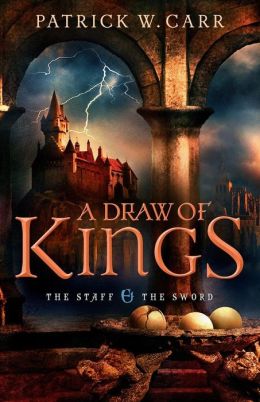
A Draw of Kings, by Patrick W. Carr


A Draw of Kings, by Patrick W. Carr 

Genre: Teen / Christian Fiction / Fantasy

Reason for Reading: This was a galley copy provided by the publisher through Netgalley in exchange for an honest review. This is the third book in a trilogy that I have been enjoying. 

Synopsis (May contain slight spoilers for previous books in the trilogy): In this third, and final, book of the Staff and Sword trilogy, the war for Illustra begins. In order to maintain order within the Judica, Errol must retrieve The Book that was left behind in Merakh. Meanwhile, Adora and Liam must journey to the Shadowlands to make a pact with these newly discovered allies. A feeling of dread descends upon everyone, as the people of Illustra realize they are surrounded by vast armies of enemies and demon spawn. They must discover who their king and savior is - or else the barrier will never be restored and the demons will destroy Illustra.

My Thoughts: This book was every bit as good as the previous two - and it tied off most of the loose ends quite well. For fantasy fans, this book was packed with battles, intrigue, foreign lands, and ranging demon-spawn. I was also quite impressed with Carr's ability to write religious allegory. He deftly got his message across by showing it within the story instead of writing lectures into the dialog as many authors do. In fact, I bumped this book up an extra half a star (something I rarely do) because I admire how much finesse it takes to write a good allegory without sermonizing. 

One of the allegorical issues presented is the fallibility of humans (as well as the organizations that we create). The church, in Carr's world, was composed of many good men (as well as a few villains) who often made mistakes and were suffering under misunderstandings of God which had accumulated after the loss of their religious book. This is the message that I originally interpreted as criticisms of the Catholic Church in my review of Hero's Lot, though after reading this book the criticism feels more forgiving. The message is: no one is perfect, we are all human, and we're going to make mistakes. We can't judge everyone in a group based upon the mistakes of some of its leaders. I'm not sure if this is the message that Carr intended, but it is how I felt when I read A Draw of Kings

The other allegorical message that I felt was done tremendously well related to faith and doubt. There was a moment when Adora as climbing a cliff and Liam was behind her, and even though she knew Liam was there to catch her if she fell, she suddenly doubted that he was there at all - that he had ever been there. And then he carried her. I'm sorry if that is a spoiler, but I couldn't help but point out the beauty of that moment. Because it's so true, isn't it? It's so easy to lose faith - even though this loss of faith is irrational when viewed from the outside-the-moment.

My interpretation of this story has evolved so much while reading this third book, that I feel I ought to go back and revise some of the criticisms I made about the second book. Of course, I always have to include criticisms, but.... Which brings me around to my criticisms of A Draw of Kings. My first complaint is how violent it was. I felt that the good guys (Adora especially) were sometimes more violent than they ought to have been. Of course, this could simply be another way in which we are only human - and therefore fallible. So this is only a small criticism. The other criticism is that I felt threads were dropped in relation to the countries other than Merakh. There needed to be a little more tie-up after that much build-up. But that, too, is only a minor issue since the major threads were tied up wonderfully.

Overall I was greatly pleased with this book, and I will recommend it to all of my friends who read books of this genre. In fact, I'm hoping it wins some awards - it's well-deserving of the Christy Award for Young Adult literature.

Wednesday, December 5, 2012

The Rape of Nanking, by Iris Chang

2012 Book 165: The Rape of Nanking

Written by Iris Chang, Narrated by Anna Fields

Reason for Reading: Reading Globally group on LibraryThing's China and surrounding countries theme read. 


Review
In the early 1930's the Chinese city of Nanking was occupied by Japanese soldiers. Tens of thousands of civilians were killed by Japanese soldiers to save money for supplies. Women were brutally raped and mutilated. But the stories of these victims and the foreigners who risked their lives to help them are not often told. Iris Chang wanted the world to know about these atrocities. Her brutal history was very difficult for me to read because the atrocities were described in such detail that I felt sick. I had to take frequent breaks. But it was a very engaging narrative, so I always wanted to pick it back up again. Chang certainly knew how to write an interesting story! Several times while reading the book, though, I felt as though Chang was too emotionally involved to write a completely reliable narrative. I'm not denying the massacres at Nanking, mind, but I think Chang had a very anti-Japanese view which would have made her prefer the larger estimates for death numbers, made especially-brutal rapes sound more common than they may have been, and made the Japanese sound purely evil as a whole group without exception. Nevertheless, this book taught me a lot about the relationship between the Chinese and the Japanese. As long as the readers keep in mind Chang's emotions, they can learn a lot from this engaging history.

I now have a hankering for a nice book about friendly, likable Japanese people. If you have any suggestions, let me know! :)


Wednesday, November 14, 2012

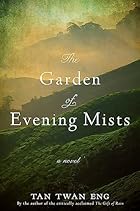
The Garden of the Evening Mists, by Tan Twan Eng

2012 Book 159: The Garden of the Evening Mists, by Tan Twan Eng

Reason for Reading: Short-listed for the 2012 Booker Prize

Review
Having suffered through a Japanese slave-camp during WWII, Yun Ling Teoh, a young Chinese-descent lawyer in Malaysia, carries around a lot of anger against the Japanese. However, she'd made a promise to her deceased sister that she would build a Japanese garden, so she reluctantly visits Aritomo - the only Japanese gardener in Malaysia. Aritomo refuses to design a garden for Yun Ling, but he offers to take her on as his apprentice so that she may design one herself. Yun Ling learns to let go of her anger as her friendship with Aritomo grows. But Aritomo has his own secrets. 

How can I express what an amazing book this was? Sure, it had a couple of slowish spots (it WAS, after all, a book about gardening) but the story is magical. The historical and cultural backdrop is intriguing (I learned a lot while reading, but didn't feel like I was being "taught"). Because the book takes place in two different times (current day and shortly after WWII), the story unfolds gracefully - allowing the reader to learn the story of Aritomo and Yun Ling at just the right rate...but yet somehow the time also blends together giving an impression of continuity that is particular to Eastern philosophy. On top of that, the more I learned about the story, the more fascinated I was by the two characters. This book is definitely worth your time. 

Interpretive note with possible spoilers
One thing that struck me while I was reading this book is that I noticed an inconsistency in what the narrator (Yun Ling) was saying. At first, I wasn't sure whether the author had made a mistake or if he had purposely introduced inconsistencies to show that Yun Ling had either an unreliable memory or was hiding something. I finally came to the later conclusion (though the unreliable memory was possible too). I think it's fascinating that such inconsistencies added to the overall effect rather than subtracting from it. I applaud Tan Twan Eng for his careful writing of this book. :)

Sunday, July 29, 2012

I Shall Not Hate, Izzeldin Abuelaish


2012 Book 112: I Shall Not Hate, by Izzeldin Abuelaish (7/23/2012)

Reason for Reading: Reading Globally Middle Eastern theme read

My Review 
In this heartbreaking (yet strangely uplifting) memoir, Abuelaish relates his life—growing up in poverty in a Palestinian refugee camp, slaving so that he could raise enough money to go to medical school, and his rising career coincident with his growing family. Despite losing 3 daughters and a niece to an Israeli military action, Abuelaish preaches that love, not hate, is required to bring peace. Abuelaish’s story is engrossing and tragic, yet I couldn’t help but think about all of the suffering Palestinians who don’t have a voice. If life is so hard for someone who has powerful connections, what must it be like for those who have no one to help them? This is a must-read for people who think Palestinians are all about terrorism and throwing rocks—people who likely wouldn’t touch the book with a 10-foot pole. It’s also a fantastic read for someone who is sympathetic to both sides of the conflict, but who wants to hear a personal story. I DO wish I could read the story of someone who isn’t highly connected, but this is a fantastic start. And Abuelaish’s enduring message of love make a monumental memoir.

Sunday, July 8, 2012

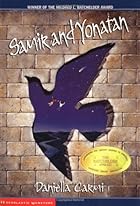
Samir and Yonatan, Daniella Carmi


2012 Book 101: Samir and Yonatan, by Daniella Carmi (7/7/2012)


Reason for Reading: I read this for the Middle Eastern literature theme for Reading Globally

My Review 3.5/5 stars
When Palestinian boy Samir breaks his knee, he must stay in a Jewish hospital for a special surgery. There, he faces his fears of Israelis and make a new friend. This is a cute story with the we're-not-so-different-after-all moral. Although it may resonate more strongly with the Israeli kids for whom it was originally written, its translation is a good addition to English-language children's literature as well. It was enjoyable and cute, and has a moral that every child in the world can benefit from.

Friday, July 6, 2012

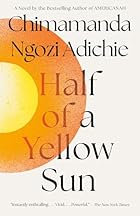
Half of a Yellow Sun, by Chimamanda Ngozi Adichie


2012 Book 100: Half of a Yellow Sun, by Chimamanda Ngozi Adichie (7/5/2012)

Reason for Reading: Mostly, I read this book because I was interested it in...but it fit in nicely with Orange July.

My Review 5/5 stars
Half of a Yellow Sun takes place in Nigeria during the Nigeria/Biafa civil war. The narrative follows 3 characters: Ugwu, a village boy who is taken in by some politically-inclined academics as a house boy; Olanna, Ugwu's mistress and a rich heiress; and Richard, a British expat who desperately wants to be accepted by the Biafrans as one of them. The stories of these three characters are superbly and tragically woven together on a backdrop of war, racial hatred, and famine. This is one of the most impressive books I've read in quite a while. The characters were so deep that I felt I knew them. The events described had an eerie realism to them that comes from the author's intimate knowledge of the history and people. This is one of those books that makes you feel like every incident described is important and well-planned. This is a story not only of war, but of people--their dreams, their loves, their fears, their strengths and weaknesses. Half of a Yellow Sun is a must-read for anyone interested in international literature.

Sunday, May 13, 2012

Surrender the Dawn, by MaryLu Tyndall


2012 Book 75: Surrender the Dawn, by MaryLu Tyndall (5/12/2012)

Reason for Reading: ACFW bookclub choice for May

My Review 4/5stars
Because all the men in her family have left to fight in the War of 1812, Cassandra Channing must financially support her family. She desperately decides to invest the rest of the family’s money in a privateering ship captained by the town rake Luke Heaton. Because she is forced to trust someone outwardly untrustworthy, she is forced to come to grips with the fact that not everything is as it seems…and sometimes she should have more faith. This is the third book in the Surrender to Destiny trilogy, but I read it as a stand-alone book. (It works fine that way.) However, I liked it so much, I’m planning on reading the first two in the series, as well…just so I can get a complete picture of all the characters. This book is a sweet romance with an interesting historical backdrop. It definitely has a religious message, but it is never preachy. I think it was just what I needed at the moment.

From Darkness Won, by Jill Williamson


2012 Book 73: From Darkness Won, by Jill Williamson. (5/6/2012)

Reason for Reading: Third book in the Blood of Kings Trilogy

My Review 3/5 stars
In this final installment of the Blood of Kings trilogy, Vrell and Achan battle their adolescent romantic problems as well as the forces of evil. I was happy with the outcome of the book, but felt the story dragged a bit. Like I said in my review of the second book, To Darkness Fled, although the story is fantastic, this trilogy does not have enough plot to last three books. It could have made such a sweet standalone book! On the other hand, the characters are very well-developed and lovable (even though their adolescent vices are a tad frustrating at times). And there was a good story to it. The trilogy would appeal only to readers of Christian Fiction—the religious message gets to the point of sermonizing at a couple of points.

Tuesday, May 1, 2012

The Complete Persepolis, by Marjane Satrapi


2012 Book 24: The Complete Persepolis, by Marjane Satrapi (2/7/2012)

Reason for reading: I wanted to read a YA book with Muslims in it, though this turned out to be neither YA nor to have very much about the Muslim faith. But it was still enjoyable.

Personal note: I am currently reading The Landmark Xenophon's Hellenika and I keep coming across the word "satrap," which is the title of a governor of a provence in ancient Persia. So it was very amusing to me to come across the modern Persian name Satrapi. I feel like I've made a connection. :)

My Review: 4/5 stars
Persepolis is a graphic memoir about Marjane Satrapi, a young “modernized” girl growing up in Iran during the Islamic revolution. Due to the trials of being an outspoken modern girl in this oppressive regime, she must leave her family and live alone in Austria to finish her education. There, she loses herself before finally coming to terms with her own identity. It was a heartbreaking memoir. The story and art were very dark, but humorous as well. I thought this book would be for young adults, but feel it would appropriate only for a VERY mature teenager. It has topics such as torture, rape, violence, and drugs. It was very educational about the revolutionary regime, though I don’t know how biased it is.