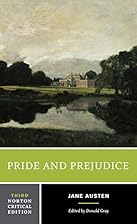
2012 Book 148: Pride and Prejudice (A Norton Critical Edition)
written by Jane Austen, edited by Donald J. Gray
Reason for Reading: Technically, I read this book on a whim. However, I'm trying to get through all the lessons from The Great Courses: Western Literary Canon, and this book is conveniently lecture 24. Out of order, yes, but perhaps the book gods will be forgiving. I won't consider this lesson complete, though, until I read the recommended critiques and biographies. I also intend on re-reading some more Austen books, and some contemporary authors and authors who are said to have influenced Austen. So I'm not done with the lesson yet!
My Review
The Bennet household is in a bit of a financial bind. They have five unmarried daughters with almost no dowry, and the estate is to be inherited by a mysterious cousin that no one's met yet. But things get exciting when a rich bachelor moves to town and brings is even richer bachelor friend. Every young lady in the area is ready to throw themselves at these men. Except, of course, for Elizabeth Bennet. She instantly decides that the rich bachelor is perfect for her sister, Jane, and his richer friend is the most detestable man on the planet. Thus starts one of the best-loved romances in Western literature. And, like most everyone else, I loved this story. Even on the nth reading of it. :)
 This book is also a social satire, which is a fact unfortunately ignored by many readers. I think many of the people who hate the book (mostly men) see it simply as a romance and don't look any further. This failing to see the humor was one of the reasons I so loathed Seth Graham-Smith's Pride and Prejudice and Zombies. I had high hopes that he had managed to weave Austen's sense of humor (i.e. a wry, witty social satire) with zombie-whacking humor. I would have eaten such a book alive. :D But, alas, Graham-Smith clearly didn't understand the humor in P&P...I wasted a couple hours of my life on that book that I will NEVER get back again.
 Since there's not much else I can say in a mini-review of the story that hasn't been said over and over, I'll discuss the supplementary material in the Norton Critical Edition. There wasn't a LOT of supplementary information in the book, but it was generally of good quality. It started with a biography of Austen, punctuated with letters written by the author. This part would be helpful to someone who isn't familiar with Austen's life, but wouldn't be particularly new to anyone who's read a biography of her. Additionally, there were several critical analyses of Pride and Prejudice, both contemporary and modern. I enjoyed most of these--though I admit I got bored with the Freudian one and moved on to the next. The piece I found most surprising was the interview with Colin Firth. I really didn't think that this interview belonged in a critical edition of P&P and wasn't expecting much from it. But I was very wrong. Colin Firth had a strong understanding of Darcy's character (of course! how could I doubt? It IS his job!). It was fascinating to read his thoughts about how he incorporated his understanding of Darcy's motivations in the most powerful scenes (such as the first ball, the drawing room discussion when Lizzy was at Netherfield, the dance at Netherfield, and the proposal). It gave me a completely new impression of Darcy's character and made me want to watch the whole miniseries again.
I found the excerpt by Marilyn Butler Jane Austen and the War of Ideas: Pride and Prejudice, quite helpful...I feel encouraged to read Butler's entire book (after I finish re-reading the rest of Austen's novels). In this excerpt, Butler shows how Darcy and Elizabeth have elements of both pride and prejudice in their personalities. I had always thought about Darcy being proud and Elizabeth being prejudiced...but now I see that it is not that simple. Darcy was proud of his lineage and wealth, and he was prejudiced against people who had less wealth and less sophistication than himself. Elizabeth was prejudiced against Darcy because of his initial bad impression, but she was too proud to allow for the possibility that she might be mistaken in her first impressions.
SPOILERS START HERE
She stubbornly liked Wickham, despite the fact that he said he wouldn't speak ill of Darcy, and yet gossiped about Darcy till the cows came home...despite the fact that he said he had no reason to avoid Darcy, and yet ran off when the ball came 'round...despite the fact that he was clearly a fortune hunter. Furthermore, Elizabeth stubbornly detested Darcy, even though she was warned by Jane and Miss Bingley that there might be more to the story than Wickham acknowledged....despite the fact that Darcy made clear efforts to be more polite to her as he got to know her better....despite the fact that he politely asked her not to "sketch his character" at the present moment because it would do neither of them any justice.
I had never before thought of the flaws of Elizabeth's character. But, indeed, she had to have flaws so that she could develop throughout the book. One of her most amusing flaws was that she was judgmental and critical of everyone--and THAT is exactly the complaint she had of Mr. Darcy's character! It is quite common, I suppose, to detest your own flaws when you see them in other people. :)
I think this is an
interesting time to insert the Jane Austen Character Quiz. I was a little annoyed at question 7 which asks
which actress would play me in a movie, because if I said I'd be played by Gwenneth
Paltrow, isn't that just ASKING to be Emma? So I decided to take
the quiz several times, and see what answer I got for EACH of the actresses. It
turns out that I would be Elizabeth Bennet for five of the seven actress
choices, and I would be Elinor Dashwood if played by Emma Thompson, and Anne
Elliot if played by Amanda Root. I took that to mean that I COULD be Elinor if I really wanted to be, but really
I was Elizabeth.
I was a little put out at first. I really wanted to be Elinor. But, then again, I am really NONE of the Austen characters, am I? I did some thinking about this issue, though. And I considered: Elizabeth Bennet's most outstanding characteristics are that she's witty/sarcastic and fun-loving. I don't know if I'm particularly witty, but I am a bit sarcastic, and I think I'm fun-loving as well. Her characteristic that drives the plot of Pride and Prejudice, however, is that she tends to be critical of her fellow humans, makes strong and lasting immediate impressions, and stubbornly sticks to these first impressions despite contradictory evidence. I don't really want to be those things. But you know what? I don't think those are good characteristics, but, as I said above, we tend to detest our own flaws when we see them in other people. ;) I have been writing a lot of letters to my cousin Steve lately, and it made me realize that I spend an awful lot of time criticizing other people. Not that I feel I'm BETTER than those other people...but, still, I was surprised that I must seem (to Steve) to be rather judgmental. This was a side of my personality that I hadn't seen before, because I'd never had the chance to talk so freely as I do in those prolific letters. So...perhaps the quiz knows what it's talking about after all?

The Great Courses: Western Literary Canon
Lecture 24: Pride and Prejudice, Women in the Canon
SPOILERS CONTINUED
I'll just finish up with some comments on Lecture 24 in the Western Literary Canon course. Professor Bowers begins by pointing out that, unlike many other canonical works, Jane Austen's books are generally read for pure pleasure. I found similar opinions in the Norton Critical Edition. Apparently, one really shouldn't look for a "deeper meaning" in Austen's books--they're simply not that deep. They're meant to entertain, not to educate. I suppose I can understand this point of view, as Pride and Prejudice is certainly less deep than Candide, by Voltaire (for example). They are both social satires, but Austen is much lighter. :) Professor Bowers claims that the charm of Austen's books is that she portrayed humanity accurately and honestly. I think this is true in that her books portray human folly. However, I feel many of her characters satirize human folly to (humorous) extremes.
Jane Austen was one of the first women authors who was accepted into the "Western literary canon." Mostly, the great critics-on-high chose books by deeply educated male authors. However, once Austen was accepted, critics opened to the idea of women canonical authors ,and efforts were made to retreat into history and rescue women authors who deserve canonical status like Sappho, Marie deFrance, and
Christine de Pizan. Professor Bowers didn't point this out, but another impact that I think Austen had is that she is the mother of "regency romance." Most regency romances today are thematically copied from Austen's style. Regency romances, ranging from Christian to erotica, abound in today's market.
Bowers makes the interesting point that Mrs. Bennet is the protagonist of Pride and Prejudice by Aristotelian view--she is the one who schemes to get her daughters married, and she is the one whose dreams come true. Margaret Drabble, in her introduction to Pride and Prejudice [1], even suggests that Mrs. Bennet may be simply misunderstood by modern readers. Due to the circumstances and time, her life revolves around finding suitable husbands for her daughters to ensure that they don't end up poverty-stricken old maids. She is, perhaps, a bit over-zealous and foolish in her attempts at matchmaking...but her intentions are very maternal. This is an interpretation of Mrs. Bennet that I have never considered, and I found it refreshing.
On this reading, I wasn't any less impressed by the silliness of Mrs. Bennet than I had previously been; but I was surprised at a new opinion of Mr. Bennet. I had always considered him to be a sensible man with a delightfully sarcastic edge. But he wasn't at all sensible. He SHOULD have laid aside money over the years instead of assuming he'd eventually have a son. When he realized he wasn't going to have a son, he should have made more efforts to keep Mrs. Bennet from overspending. Instead of laughing at the folly of his daughters and wife, he should have spoken some sense into them--at the very least into his daughters. By laughing at their folly, he allowed them to expose themselves both to ridicule and to the preying eyes of ungentlemanly men. He shouldn't have encouraged his daughters to laugh at his wife. He is just as much at fault for the ridiculousness of the family as his wife is.
[1] Austen, Jane. Pride and Prejudice. New York: Penguin Group 2008. ISBN: 1-101-08421-98
Texts that I have read for this lesson:
Jane Austen: Pride and Prejudice (Norton Critical Edition) (required reading)
 2012 Book 152: Harry Potter and the Chamber of Secrets