Showing posts with label England. Show all posts

Tuesday, March 18, 2014

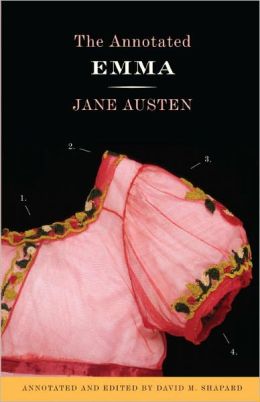
The Annotated Emma, by Jane Austen


The Annotated Emma, by Jane Austen

Genre: Classic / Regency Romance

Reason for Reading: I'm rereading all of Austen's novels. I've seen these Annotated versions and been tempted to try them out for a while, and this is the one I ended up picking up. 

Synopsis: Emma is young, rich, beautiful, and the most important gentleman's daughter in her neighborhood. When her governess marries and moves away, Emma must find another friend to entertain herself. She chooses Harriet Smith, the love-child of nobody-knows-whom, and boarder at a local country school for girls. Emma, well-meaning but naively self-important, makes a mess by foisting potential suitors upon poor Harriet, while Emma's old friend Mr. Knightly tries in vain to check Emma's eager naivete. 

My thoughts: I'm a huge fan of Jane Austen. This is the third time I've read this novel, and I've seen all the movie renditions multiple times. I love watching Emma grow in wisdom throughout the story. And her romance is, in my opinion, the sweetest of those written by Austen. But I recognize that this is a difficult book for many people to get into because of Emma's painful flaws and poor choices. Another reason that Emma is less appealing to some readers is because the narrator's perspective is so unique. The POV focuses almost entirely on Emma's perception of the world, to the point where it is easy to be mislead about what is really occurring since we are only seeing what Emma sees. Emma, especially at the beginning of the novel, tends to be very self-centered and aloof, and so is the narration of the novel. However, even though this POV makes the story harder to get into than the other Austen novels, this is Austen's most appealing work for character study.  

The annotations of this book are lengthy and detailed. Many interesting images and comments are included so that we can visualize antique customs, fashions, and furniture that Austen's readers would take for granted. That aspect of the annotations was fantastic. The annotations also included a lot of character analysis commentary, such as "Emma thinks such-and-such is happening, which shows you how much she lacks self-awareness at this stage." These annotations included a lot of spoilers (the reader is warned which annotations include spoilers, but sometimes these warnings were dropped out of the ebook version - so caution should  be practiced if you're reading the book for the first time and you have ebook format). These character analysis annotations were sometimes interesting, but mostly they told me things I'd already knew - either because I was familiar with the story or because I am sensitive to Austen's nuances. Therefore, I think this annotated version is for you if 1)You are interested in having some historical perspective, 2)You are reading the book for the first time and don't mind spoilers, 3)You're re-reading the book, but don't remember the details and nuances, and/or 4)You just love reading annotations. In other words, I am glad that I read this one book from The Annotated Austen series, because I enjoyed the historical perspective notes, but I probably will not pick up any of the others because I think I got the main idea now. 


Wednesday, May 29, 2013

Maisie Dobbs, by Jacqueline Winspear

Maisie Dobbs

Written by Jacqueline Winspear, Narrated by Rita Barrington

Reason for Reading: Real Life book club

Genre: Historical Fiction / Mystery / Women's Fiction

Review
Maisie Dobbs is disappointed when her first case as a PI is to investigate a potential infidelity; however, things get a little more interesting when her investigation brings to light a suspicious death in a home for soldiers injured in WWI. But investigating the home turns out to be more dangerous than she'd thought. 

This book was WAY outside my box. I generally don't read women's fiction or books that have a feminist leaning - though sometimes I enjoy such books. So this mystery wasn't for me. The mystery part of the story was very light - she investigated a potential infidelity at the beginning, and at the end she investigated a suspicious home for injured soldiers. The middle half of the book was all Maisie's background and character development, which I found off-topic and a bit contrived. Maisie is one of those WWI women who did absolutely everything the stereotypical WWI literary woman does. She got caught up in the feminist movement (somewhat), was educated beyond her class and gender, lied about her age so she could be a nurse in France, etc. etc. It's like Winspear took a list of WWI woman stereotypes and checked them all off. Thus, I felt absolutely no empathy for Maisie's character because she felt so fake to me. The little touch of mystery at the beginning and the end wasn't enough to save the book. 

I can see that many readers would love this book - if you like women PI's, especially of the historical variety, then this is probably a good book for you. The series IS popular. It just wasn't for me. *shrug*

Monday, May 27, 2013

The Ghost Map, by Steven Johnson

The Ghost Map

Written by Steven Johnson, Narrated by Alan Sklar

Reason for Reading: Science, Religion, and History group read

Genre: Non-fiction - Medicine and History


Review
The Ghost Map follows Dr. John Snow on his quest to discover the cause of a terrible cholera outbreak in Victorian England. Johnson makes investigative epidemiology so interesting that I could almost see it dramatized (and fictionalized) into a TV show - people DO love their investigative TV! :) But that's beside the point, I guess. At the time of this outbreak in 1854, the popular theory for the spread of cholera was miasma - deathly air that carried disease. After a LOT of investigative footwork, Snow drew a map of the cholera outbreak, demonstrating that the pattern followed streets that led to a particular well (the Broad Street pump) rather than following a circular pattern you'd expect with the spread of bad air. This map, and the investigation leading up to its creation, revolutionized epidemiology. In fact, many consider Snow the "first epidemiologist." 

I really enjoyed this book. The writing was engaging (it had a few boring parts in the end when Johnson was describing the map in great detail - I think that may be a problem with listening to the audio book rather than actually reading it, though). The subject was fascinating. Sklar did a good job of narrating the book, and except for the very end with the description of the map, I was quite pleased with the book's audio version. If you have any interest in epidemiology, or the history of medicine, I highly recommend this book.

Monday, April 22, 2013

Harry Potter and the Half-Blood Prince, by J. K. Rowling

Harry Potter and the Half-Blood Prince

Written by J. K. Rowling, Narrated by Jim Dale

Reason for Reading: Re-reading the Harry Potter series in audio format. 


Review

(Contains spoilers from earlier books in series)

The Ministry of Magic has finally admitted that Voldemort has returned, and Dumbledore has returned as Hogwarts Headmaster. Furthermore, Dumbledore has realized that it was a huge mistake to leave Harry in the dark for so long. He and Harry become much closer in Harry's sixth year at Hogwarts, as Dumbledore reveals much of what he knows of Voldemort's history and motivations to Harry. Harry is also kept busy with his new obsession that Draco Malfoy is up to new levels of "no good." Ron and Hermione poo-poo his suspicions and keep themselves busy with escalating romantic tension. 

Altogether, this book has a LOT going on, yet it's more compact than the previous two books. Overall, I think this is Rowling's best written book in the series, even if my favorites are the first four. I really enjoyed this re-read of the 6th book in the Harry Potter series - it's only my second time reading this book, and I had forgotten a lot of it. The romantic tension between Ron and Hermione is my favorite part of the book, since it'd been building for SO long and was finally let loose terrifically. :) 

Jim Dale's reading, as usual, is excellent. It took some getting used to, but after the first or second book it really grew on me. I know all his voices for the characters, and that really ads to my enjoyment of the story. 

Wednesday, March 13, 2013

Unnatural Issue, by Mercedes Lackey

Unnatural Issue

Written by Mercedes Lackey,  Narrated by Kate Reading

Reason for Reading: This was meant to be included in a fairy tale challenge in February, but that didn't work out for me too well. But I'm still going to finish up my Donkeyskin books, regardless! 


Review
When Earth Master Richard Whitestone's wife dies in childbirth, he discards their newborn  daughter Suzanne in a fit of rage. Suzanne is raised as a servant of the household, while her father wastes away in his chambers. After many years, Whitestone develops a new passion - necromancy. When he sees his daughter wandering his lands, he realizes she is the perfect vessel in which to trap his dead wife's spirit. Suzanne must flee her father, and hide in the guise of a servant in another household. But her skill in Earth magic is difficult to hide...

This is a non-canonical retelling of the fairy tale Donkeyskin, and is part of Lakey's Elemental Master series. Although it certainly has charm and originality, it is not my favorite of the Donkeyskin retellings, nor of the Elemental Master series. I felt the premise of the book - a necromantic father, Elemental Masters fighting in WWI, with a touch of romance - had promise. Unfortunately, it just wasn't delivered as well as it could have been. The romance seemed forced, and the war sections uninteresting. Not that it was a terrible book, but it could have been so much better. Lackey is better than this. 

But, if you're looking for a fluffy-quick read, or an original fairy tale retelling, this book will certainly deliver that. :) The narration by Kate Reading was quite good. She did the voices well, and had good timing. 

Thursday, January 17, 2013

Midnight Riot, by Ben Aaronovitch

Midnight Riot 

Written by Ben Aaronovitch, Narrated by Kobna Holdbrook-Smith

Reason for Reading: Real-life Book Club

Review
Peter Grant is a bumbling, easily distracted constable on the fast-track for a paper-pushing job. His luck unexpectedly turns when a ghost approaches him at a murder scene. Apparently Grant does have a talent - he can see dead people. Suddenly, he is adopted as the sole apprentice of Detective Chief Inspector Nightengale, who heads the supernatural division of the police. Grant is up to his ears in weirdness as he tries to solve the murder while learning the ropes in the unexpectedly supernatural world. I mostly enjoyed Midnight Riot for its interesting world-building and a lot of dry humor. The character of Grant was likable enough - even if he was bumbling - and I suspect I'd grow attached to him after a few books in the series. The plot tended to stray a bit more than I prefer, though. Nothing too bad, mind you, but there were a few moments where I wondered if we were still trying to catch the murderer or just enjoy the scenery. I prefer a little more focus. But these passages were never very long, and the book was, for the most part, quite enjoyable. I'm sure I'll pick up the next in the series some day.

As for the narration by Kobna Holdbrook-Smith...I think his cadence, tone, and delivery was done perfectly for our character. He was so dead-pan with the dry humor that I sometimes only caught the humor by delayed reaction. Which made it funnier. :) On the other hand, he was a rather loud (and wet) breather. I figured at first that this was put on for the character effect - but then I realized that such breathing would be difficult to fake unless he narrator was really congested. So...the loud breathing wasn't enough to put me off, but it might be enough to put SOME people off. 

Wednesday, January 16, 2013

Harry Potter and the Order of the Phoenix, by J. K. Rowling

Harry Potter and the Order of the Phoenix

Written by J. K. Rowling, Narrated by Jim Dale

Reason for Reading: I've been going through the Harry Potter books by audio now. This is my first time reading straight through the entire series, and by "straight" I mean I finish one every one or two months. ;)

Review (WARNING: Contains unavoidable spoilers from earlier novels!!!)
Voldemort has recently returned, and Harry Potter has spent the entire summer listening to the muggle news for some sign of terror. But it turns out that most people don't believe Harry and Dumbledore that Voldemort has risen, and Voldemort is using that ignorance to his advantage.  Furthermore, the Ministry of Magic has decided that Dumbledore isn't stable, and they're interfering at Hogwarts with the addition of a new teacher - the throttle-worthy Dolores Umbridge. *Yes. I wanted to throttle her EVERY time she entered the narrative. That shows excellent caricaturization by Rowling.* This year, Harry must battle the disciplinary hand of the Ministry and skepticism from his fellow students, without losing focus on his upcoming OWL exams. Will he pass Potions?!

This is one of the more complex books in the series (which wins it bonus points with me), but it is also the angstiest book. Harry spends the entire book angry at his friends, angry at Dumbledore, angry at the Ministry, angry at Umbridge, and just plain pissed off in general. His confusion is compounded by his interest in Cho, who is still mourning the death of her dead boyfriend Cedric. Overall, it's a good book because it advances the story and develops character, but I got a bit tired of angsty Harry. This is my least favorite (though still highly enjoyable) of the Harry Potter books.

Jim Dale's narration is quite enjoyable now that I've gotten used to it. He has recognizable voices for each of the characters, and his voice is entertaining and engrossing.

Tuesday, January 15, 2013

Sense and Sensibility, by Jane Austen

Sense and Sensibility, by Jane Austen

Reason for Reading: Well, actually, it was an accident. I watched the BBC movie with my mom and she asked me how similar it was to the book. I said that it was very close to the book, but that there were a few things in the movie that I didn't really believe happened that way in the book. So I picked up the book and started reading. Got sucked in. :) I was wrong, though, all three incidents happened in the book. 

Review
This is the story of two very different sisters: Elinor is a sensible (yet secretly passionate) young woman who must continuously reign in the wild passions of her mother and sisters - especially Marianne whose head is filled with romantic notions of one-true-love and tragedy. When their father suddenly dies with their newly-acquired estate entailed away to their half-brother John, the sisters are left destitute. John and his wife Fanny descend upon the mourning family within a fortnight and make the sisters and mother feel like unwelcome guests in their beloved home. Elinor soon forms an attachment with Fanny's brother Edward, but Fanny doesn't approve of Elinor's lack-of-fortune-or-name. So the family moves away to a cottage, leaving Edward behind. Poor Elinor must struggle with her own worries about Edward while at the same time monitoring the expensive of the house and trying to reign in the wild, all-consuming attachment of Marianne to the dashing young Willoughby. The romantic hopes of both girls spiral downwards as more and more obstacles appear. 

I love this story because I've always admired Elinor for both her passion and her ability to handle all problems that come her way. I also admire Colonel Brandon for his devotion to Marianne despite her ecstatic preference for the younger, handsomer, and less reserved Willoughby. This time around, I also really appreciated Marianne's character. Her youthful ideas about love were cute - and realistic for many girls of 16. :) Her development throughout the story was extraordinary. I loved the way she slowly, cluelessly, began to understand the world around her. I don't admire her, but I think she's cute and very funny. And, frankly, a more interesting character than Elinor (due to her development-of-character).

To be honest, this book is just as much a favorite as Pride and Prejudice. Yes. That is right. I ADMIT that I like this book just as much (possibly a little more) than the beloved P&P.

Monday, December 31, 2012

Old Curiosity Shop, by Charles Dickens

The Old Curiosity Shop, 

Written by Charles Dickens, Narrated by George Hagan

Reason for Reading: I'm making a point of reading all of Dickens' major works. This month, Caroline from Beauty is a Sleeping Cat and Delia from Postcards from Asia hosted Dickens in December, a month dedicated to Charles Dickens. This will also count for the 7th completed book in my Classics Club list

Review 
When Little Nell's grandfather drives himself into gambling debt (in hopes of raising money for Nell's future), they must take to the streets to escape the malicious designs of more than one nasty character. Nell's grandfather increasingly becomes a doddering old fool, and Nell is left to her own devices in finding refuge from the cold, the hunger, and the devious people-of-the-streets. Unbeknownst to them, their good friend (and former servant) Kit is desperately looking for them - praying for their safety and not knowing why they have left. I think this is my least favorite Dickens book so far. Generally, I am able to get involved in the complex narrative and the variety of character in a Dickens novel, but kit was the only character I really cared much about. Nell and her grandfather were so melodramatically pathetic that, although I felt sorry for their situation, I couldn't get myself to really care about the outcome. Perhaps this was just timing - maybe I'd have liked the book better in another mood. But I can't say I'll ever try reading it again to find out. Not a bad book - but Dickens can do better.


Saturday, December 22, 2012

A Christmas Carol, by Charles Dickens

2012 Book 172: A Christmas Carol

Written by Charles Dickens, Narrated by Tim Curry

Reason for Reading: I read this for a Dickens in December readalong hosted by Beauty is a Sleeping Cat and Postcards from Asia. Unfortunately, I'm a day behind on my post! This is also one of the 1001 Books You Must Read Before You Die (sign-up for Team 1001 here).

Review (contains spoilers :p)
When grumpy and miserly Ebeneezer Scrooge is visited by the ghost of his long-deceased business partner, he gets the shock of his life. Apparently, a person's job on earth is to walk among his fellow men and help them. For those who were too selfish to help during life, they are doomed to an eternity of walking among men while desiring to help, but not being able to. Scrooge is about to be given a chance at redemption. He will be visited by three ghosts. The Ghost of Christmas Past will remind him that although he'd had a rather dreary childhood, he'd had plenty of chances to make people (rather than wealth) his passion. The Ghost of Christmas Present will show him how happy people can be when they are surrounded by the people they love at Christmas. And the Ghost of Christmas Future will reveal a dreary future which may come to pass if Scrooge continues on his miserly path. On Christmas morning, Scrooge will awaken a new man - someone who knows how important it is to love one's neighbors and to rejoice in their friendship. This is such a great story because it reminds us that wealth does not necessarily make us happy. It reminds us to look at the world through a different perspective. And, it's pretty darned funny. :) 

This well-known story was excellently narrated by Tim Curry...and I'm SO glad I decided to pay the extra couple of dollars for the Curry narration! His voice is soothing yet engaging at the same time. His voices for each character are spot on. And his delivery of the humor was so well-timed! 


Monday, December 17, 2012

Three Men in a Boat, by Jerome K. Jerome

2012 Book 168: Three Men in a Boat (To Say Nothing of the Dog)

Written by Jerome K. Jerome, Narrated by Frederick Davidson

Reason for Reading: This was my "monthly random pick" which took me two months to get to. :) My next "monthly random pick" is The Passage, by Justin Cronin. This book is a classic, so it fits in my Classics Club list. :) 

Review
In this classic novel of humor, three men (to say nothing of the dog) decide to cure their hypochondriac ailments by getting fresh air and exercise. They decide to travel down the Thames in a boat. The narrator jumps back and forth between humorous description of their preparations/trip and silly reminiscences of loosely connected incidents about the characters. This is the type of book where, at the end, you're not sure if there was any story in there at all, but you certainly enjoyed the trip regardless. It was a good-natured, happy sort of humor. This is a short book, and certainly worth reading if you like the classics. :)


Friday, November 30, 2012

Harry Potter and the Goblet of Fire, by J. K. Rowling

2012 Book 162: Harry Potter and the Goblet of Fire

Written by J. K. Rowling, Narrated by Jim Dale

Reason for Reading: Harry Potter Read-along hosted by Lost Generation Reader.


Review
In this fourth installment of the Harry Potter series, Harry is thrust against his will into the Triwizard Tournament - a competition for which he is his underaged and underqualified. Is someone trying to get him killed? Furthermore, Harry, Ron, and Hermione are experiencing the first pangs of teenaged angst. They all feel misunderstood and a bit angry at times. Will they be able to overcome their emotions in order to quash the rising power of Lord Voldemort? Well, at least they'll have a lot of adventure while they're trying. One of the highlights of this book is meeting the students of the two other large wizarding schools in Europe: The dark and broody students from Durmstrang and the too-formal sissies from Beauxbatons. (Ok, maybe they're not ALL sissies.) ;) This is my favorite book of the series because it has *swoon* Viktor Krum. It is also the first book in the series with "mature" content. It's longer, moodier, and more dangerous than the first three. And, it's the first book in the series to leave significant strings untied - leaving room for more plot development. I'm SO glad Rowling knew what to tie up and what to leave open though. She's managed to leave a reasonable opening without cliffhangers. I really appreciate that. Thank you Ms. Rowling!


Saturday, November 10, 2012

Harry Potter and the Prisoner of Azkaban, by J. K. Rowling

2012 Book 155: Harry Potter and the Prisoner of Azkaban

Written by J. K. Rowling, Narrated by Jim Dale

Reason for Reading: I read this for Lost Generation Reader's Harry Potter Readalong. On which I'm falling catastrophically behind. But at least I'll get some of them read before the end of the readalong.


My Review *****
Harry Potter thinks he's in big trouble when he accidentally blows up his aunt, but luckily for him the powers-that-be are distracted by the shocking escape of Sirius Black from the wizard's prison Azkaban. Black is purported to be "You-Know-Who's biggest supporter." (Though I'm not certain what made everyone decide that Black was the most dedicated supporter, rather than the one who'd made the biggest bang? But let's not question the Rowling.) With the dementors out in force - ready to snatch Black up the moment he rears his unkempt head, Harry, Ron, and Hermione don't have much chance to misbehave. Will they catch Black before Black kills again? I loved this book more this time around than I did the first time. (Mainly because I have a fondness for the entire story now, whereas when I read it, I was just continuing a series that I'd started.) I DID notice, however, a few snafus that made me chuckle. Just little inconsistencies here and there. I didn't notice anything like that in the first two books. Usually I ignore little inconsistencies in YA lit, but these surprised me because I'd always thought Rowling had done an amazing job tying up all the loose ends. I suppose inconsistencies are almost impossible to avoid this TIME around though. ;) I remember reading some comments a while back that said that Rowling's writing developed from a bit amateurish to more skilled as the series progressed. Now I see what they mean. I'll keep an eye out for loopholes in the future, now that I know she has them. :p I'm curious if she gets a lot better at avoiding them in the later books. Overall, though, excellent stuff. I'm enjoying Dale's narrations more and more now that I'm getting used to his style. 


Thursday, November 8, 2012

Shakespeare's Hamlet - Notes on Introduction by Harold Jenkins


I'm reading the Arden Shakespeare version of Hamlet, edited by Harold Jenkins. Harold Jenkins' Introduction had a LOT of information, and I highly recommend it to someone who's serious about reading this play. Jenkins started by discussing the date of original release. Apparently there is some controversy among scholars about when the play first came out. There's about 2-3 years wiggle room of uncertainty. Apparently, this is an important question since there is a play that was released around the same time called Antonio's Revenge. Either Hamlet or Antonio's Revenge was plagiarized. We're talking the plot, the circumstances, and some of the dialog--all copied. Jenkins comes to the conclusion from his three-paged discussion about dates that Hamlet was released first. Originally, it was generally accepted that Antonio's Revenge was released first and that it was used as "source material" for Hamlet. I wasn't entirely convinced by Jenkins' argument, and am not certain whether most scholars today agree with him or accept the original conclusions that Hamlet was the later play (though I suspect the former). After so much time has passed, and considering that plagiarism wasn't as big a deal in the 16th century as it is now, I hesitate to give Shakespeare all the credit simply because he's Shakespeare. However, Jenkins did provide one argument that I found convincing. Shakespeare was basing his play on a well-known Danish tale. He shouldn't have had any use for an unrelated secondary source like Antonio's Revenge. On the other hand, Marston would have been searching for ideas for a sequel to his earlier play, Antonio and Mellida, and would have had more need for source material.

Jenkins then spends a good deal of space discussing the publication of Hamlet and the differences between existing manuscripts. I skipped that section, but it certainly contained a good deal of information that a serious scholar would find interesting.

The sources of Shakespeare's Hamlet are then discussed. Apparently, it is generally accepted that the major source of Shakespeare's Hamlet was a contemporary play dubbed by today's scholars as Ur-Hamlet. This play was never printed, so we can't compare it to Shakespeare's work, but Shakespeare would certainly have been familiar with the play since it was put out by his own company. The story that we now call Hamlet was first published in Saxo's Historiae Danicae, written at the end of the twelfth century and published in 1514. The story was then retold by the Frenchman Belleforest--translations (or the original French version) were probably what the author of Ur-Hamlet used when writing his play. It is clear that Belleforest was the source material, rather than Saxo's original work, because that Belleforest introduced some dramatic elements to the story which were present in Hamlet. For instance, the adultery of Amleth's mother was Belleforest's idea. Although it is clear that Belleforest is the source of Hamlet, it is unclear whether Shakespeare read Belleforest himself, or simply inherited the allusions from Ur-Hamlet


There were, of course, elements in Hamlet that were not evident in Belleforest's work. For instance, the complexity of Hamlet's character was Shakespeare's doing. Also, the ghost of Hamlet's father is only hinted at in Belleforest. During the revenge scene in his tale, Belleforest made passing reference to the shade of Amleth's father--that it may now rest in peace. The leap between a metaphorical shade and a full-fledged haunting was made somewhere between Belleforest and Shakespeare. Jenkins' introduction contains a lot more information about the little differences between Belleforest and Shakespeare with some speculation about Ur-Hamlet, but I'll leave all of that unsummarized so you have a reason to read the Introduction yourself. ;)

Finally, the Introduction ends with a critical analysis of Hamlet. It has been so long since I've read Hamlet, that I feel I need to go back and read this critical analysis after re-reading the play. I'll post more detailed comments on it later. The only thing that really jumped out at me during this first perusal of Jenkins' critique is that he believes that Ophelia died a virgin. I'd always heard that Ophelia and Hamlet had had relations at some point before the action commenced. The difference between these two interpretations changes Ophelia's character immensely. I'll read very carefully this time and come to my own conclusions.

Another thing that struck me while I was reading the introduction (though it wasn't directly discussed by Jenkins) is that when I first read Hamlet as a teen, I never questioned the reason why people considered the relationship between Gertrude and Claudius to be incestuous. But now I wonder. Why is it incestuous to marry your brother's widow?


This subject also came up in Wolf Hall, by Hilary Mantel. There was much discussion about Henry VIII's relationship with Catherine being incestuous because Catherine MIGHT have consummated her marriage to Henry's brother Prince Arthur. I don't recall which Bible passages were quoted in those discussions, but I remember thinking it odd that such a marriage would be considered incestuous. 

I wondered at what point did it become incestuous in Christian culture for a man to marry his brother's widow? If I recall correctly the Hebrew Bible says that thou shalt not have relations with the wife of your father, but thou must marry the widow of thy brother. Well. Maybe it was phrased differently...but I'm pretty sure that was the general idea. I don't recall anything in the New Testament saying that a man shouldn't marry his brother's widow, so where did this idea of incestuousness come from? 

I asked this question on my LibraryThing thread, and my father came up with this answer: 

Complex subject. First off, reference Leviticus 25:5


"If brethren dwell together, and one of them die, and have no child, the wife of the dead shall not marry without unto a stranger: her husband's brother shall go in unto her, and take her to him to wife, and perform the duty of an husband's brother unto her.


The duty of a surviving brother to carry on his brother's family was very important--but the issue would be his late brother's child and not his own. Thus the story of Onan in Genesis 36. Onan went to Tamar, the late Er's wife. But he withdrew early and "cast his seed upon the ground." For that, Yahweh decreed capital punishment, so Onan died as well. But the brother did not strictly marry his sister-in-law. He just got her pregnant, and it was known as a Levirate marriage. Many readers considered Onan's crime as masturbation (aka Onanism) and considered masturbation a serious sin for centuries.


As to marriage to a mother-in-law, sister-in-law, etc., these people were considered part of a household, especially if they lived in the same manor. Marriages to such always had overtones of incest, but such overtones were easily overridden among the aristocracy. But then as now, there were strict conservatives, many who held places in the hierarchy who pronounced dire consequences for everyone who did not follow the conservatives' conscience. Especially if the conservative was opposed to the marriage for politiical or economic (his own economy) reasons. Monks and priests who vowed celibacy (whether they kept their vows or now) tended to look down their Pecksniffian noses at people who did not remain celibate. 
I also wonder (maybe there are some Shakespeare scholars reading this?)...if Shakespeare had strong feelings about the incestuous nature of marrying your brother's widow, does that imply that he questioned the legitimacy of his king, James I, who was grandson to Henry VIII's "incestuous" marriage to Catherine?


Things that make you go "hmmmm."

Edited to add that Alex (in comments below) has pointed out that James I was not the grandson of Henry VIII. That just shows you what I know.
Saturday, November 3, 2012

Harry Potter and the Chamber of Secrets, by J. K. Rowling

2012 Book 152: Harry Potter and the Chamber of Secrets

written by J. K. Rowling, narrated by Jim Dale

Reason for Reading: I'm rereading these books along with Lost Generation Reader

My Review*****
Harry hopes his second year at Hogwarts School for Witchcraft and Wizardry will be calmer than last year's. However, even before the school-year begins, Harry meets a house elf who is determined to keep Harry from even STARTING his school year. Harry perseveres, however, and delves into trouble yet again when the Chamber of Secrets is opened and some stealthy beast begins to petrify his classmates. Will Harry and his friends be able to stop the beast before it manages to kill someone? Harry also gets his first taste of xenophobia in the wizarding world, when he learns a new naughty epithet (the m-word). And I bet you'd never guess which bratty little villain uses the word? I'll give a hint. He's blonde. ;)

This second installment of the Harry Potter series is just as delightful as the first. It, like its predecessor, is aimed at the younger end of the YA spectrum, which suits me just fine. The narration by Jim Dale is quite enjoyable--in fact, I liked this narration better than his narration of the Sorcerer's Stone. He's got different voices for each of the characters, and his voice definitely engaged me. 

The entire Harry Potter is a popular book on the "banned and challenged" lists released by the ALA. Personally, I didn't see anything objectionable in this book. Accusations of "satan worship" and "encourages interest in the occult" are silly. There isn't any language or objectionable morals that I can see--other than the fact that Harry, Ron, and Hermione steal, lie, and generally disobey rules. Of course, they do these things with the best intentions, and often because they feel the adults don't listen to them. Also, they don't hurt anyone with their antics (though they certainly endanger themselves). But let's be honest with each other. Would YA books be interesting to ANYBODY if the protagonists were perfect little angels who allowed the adults to take care of all the important stuff? Of course not. 


Friday, October 5, 2012

Harry Potter and the Sorcerer's Stone, by J. K. Rowling


2012 Book 142: Harry Potter and the Sorcerer's Stone


Written by J. K. Rowling, Narrated by Jim Dale


Reason for Reading: This is my third book for Book Journey's blog tour for Banned Books Week, and this time I decided to try something familiar. Since Lostgenerationreader is having a Harry Potter readalong, I decided to join in and read the first HP book for Banned Books week. :) This is probably my third time reading this particular book, but it will be my first time reading the series "in one go."


My Review:
Harry Potter has been living with his neglectful and emotionally abusive parents ever since his parents died when he was a baby. But on his 11th birthday, everything changes. He finds out that his parents were a witch and a wizard and that he, himself, has been accepted to Hogwarts, a school for witchcraft and wizardry. He is thrilled to feel comfortable and welcome for the first time in his life, but he soon discovers that not all the teachers at Hogwarts are looking after his best interest. Can Harry and his adventurous friends save the Sorcerer's Stone from being stolen and used for nefarious purposes?


Of course, you all know the answer to that question. If you don't, then you probably aren't interested in the answer and I'm surprised you've gotten this far into my review. Any comments I make about my appreciation for this book will fade in the wake of the raving of others. Therefore, I'll only comment on the Jim Dale narration (which was the narration released in the US, but which is apparently no longer for purchase--I'm not sure if they intend on putting out a different narration? Releasing the Stephen Fry narration in the US would be a kind, generous, and profitable move!) Jim Dale did a pretty good job on the narration--If I didn't already have a very set impression of what all the characters should sound like, then I'd have been much more happy with this rendition. Unfortunately for Dale, however, most anybody who would listen to this audiobook today already has a very set impression of how a centaur should sound and how to pronounce "Voldemort." This isn't Dale's fault, but I suspect his reading has been taken off the market because of these issues. However, I was quite able to ignore this rather amusing issue and enjoy the audiobook. :) I will continue with the rest of the Dale narrations.


My comments on book banning

Harry Potter is #1 Top 100 Banned/Challenged Books: 2000-2009 AND #48 on 100 most frequently challenged books: 1990–1999.  As several people commented, Harry Potter was banned for similar reasons as The Headless Cupid, which was my first Banned Books Week review. Parents are concerned that their (apparently not-very-bright and way-too-malleable) children will be driven to the darkside of the occult and Satan worship by this book. I'm afraid I have to disagree and say "that is hogwash." Harry Potter and the Sorcerer's Stone had a very clear good vs. evil message. Loyalty, bravery, and camaraderie are emphasized as important traits in the characters of Harry Potter. Love stands out as pretty much THE most powerful force of good available to humanity. That seems to be a pretty healthy message, even to a fundamentalist Christian. On the other hand, "doing ANYTHING to succeed in life" is portrayed as an undesirable characteristic. Killing or taking advantage of the innocent is touted as the most sinful act possible. People whose views of good and evil have faded away to "there's-only-the-weak-and-the-powerful" are portrayed as demented. Again, the views of "evil" that are communicated in this book are in fitting with Christian views. This is NOT a morally ambiguous book! So why are the fundamentalists so worried? Just because their kids might use their imaginations a little bit? 


Monday, September 3, 2012

The Unlikely Pilgrimage of Harold Fry, by Rachel Joyce


2012 Book 130: The Unlikely Pilgrimage of Harold Fry, by Rachel Joyce

Reason for Reading: This is the third Booker longlist book for 2012 that I've read.

My Review:
When Harold Fry gets a letter from an old friend who's dying of cancer, he decides in a leap of faith to take a pilgrimage across England to "save" her. Along the way, he meets many interesting characters and learns to listen to their troubles. He also has time to reminisce about his past...some happy memories, but mostly memories of things he should have done better. This is a bitter-sweet story with deep characters and a good message. The type of person who would love this book is sentimental, and loves reminiscent stories about past mistakes and new beginnings. 

Personally, I'm not that sort of person. Bitter-sweet stories tend to make my eyes tear up, and then I get angry at myself for being so infernally hormonal. :) Stories in which people reminisce about past mistakes also are a little depressing to me. I've always felt that we should learn from the past, but not waste energy with regrets. Everybody makes mistakes. If we regret them, do something about it. If we can't do something about it, accept it as a part of our pasts that makes us who we are today. Try not to make the mistake again. But maybe I just feel that way because I don't have anything worth regretting yet, I don't know. *shrug* 

This was a cute book, but I don't see it winning the Booker.

Sunday, September 2, 2012

The Invisible Man, by H. G. Wells

2012 Book 128: The Invisible Man, by H. G. Wells (9/1/2012)


Reason for Reading: Coursera fantasy and science fiction course


My Review
In H. G. Wells' classic novel, a scientist turns himself invisible and wreaks havoc in rural England. This book is a versatile classic because it could be read by someone who is young or who simply wants to read fluff, but it can also be appreciated by more careful readers who are looking for undercurrents of meaning. It's a tragi-farcical romp in 19th century England, but it's also a warning about what people might do simply because they can get away with it. This is a classic that anyone interested in science fiction should read.


Essay on The Invisible Man, by H.G. Wells for Coursera Fantasy and Science Fiction. May contain spoilers!!!

In his 1897 novel The Invisible Man, H. G. Wells portrayed a tragic anti-hero, a trend which had become popular among romantic writers following in the footsteps of Milton. Well's character Griffin isolated himself from humanity at first because he wanted all the glory of his discoveries. Later, he was driven to isolation by a fear of discovery. Finally, he was driven mad by the effects of his self-imposed isolation. 

Wells used two narrative styles for this novel. One style was Griffin's first person narrative. This style not only established Griffin as the protagonist of the story, but it also painted him in a tragic light: he was naked, hungry, and alone; facing the unforeseen difficulties of invisibility. He had striven diligently for success only to have it wrenched away as he recognized his own impotence in isolation. Only upon this dreadful realization did he seek out compatriots. However, he faced rejection not only from the general populace, but also from his chosen companions. Like Satan in Paradise Lost, Griffin had rebelled against the social order, and been mortified by his own failure. Like Satan, he failed to recognize his own fault in his fall, and instead sought revenge.

The other narrative style used in The Invisible Man was that of a semi-omniscient reporter/observer who told the story as seen through the eyes of individual characters. This style was distanced from the motivations of characters, resulting in the farcical effect of watching people rushing after flying objects and thrashing wildly at thin air. This narrative style made Griffin's plight seem pathetically silly. It is reminiscent of the comic debasement of Satan at the end of Paradise Lost. It suggests that Griffin doesn't deserve the tragic grandeur of a real hero--because he's just a sad little man with poor morals and no friends.


Thursday, August 30, 2012

Skios, by Michael Frayn


2012 Book 126: Skios, by Michael Frayn (8/29/2012)


Reason for Reading: I'm trying to get through at least SOME of the Booker longlist before the winner is announced. This is one of the 5 easily available in the US, and one of the 3 which is available in audiobook format (since I seem to be limited in my ability to physically read books lately, this seemed the best place to start).

My Review
Dr. Norman Wilfred has flown to Skios to give a distinguished speech to a group of rich academics at the Toppler Foundation. Due to an unfortunate string of coincidences, he is whisked off to a villa while a con artist, Oliver Fox, takes his place at the Toppler gathering. At first blush, this may seem to be only a farcical comedy of errors. Fun is poked at the distinguished empty-headedness of academia, at silly assumptions people make when they don't have all the information (which, of course, they never do), and at the openness of people to accept whatever is said--as long as it is said by a charismatic person. However, I can see why this book was chosen for the Booker longlist--upon a more careful reading this book has a much deeper undercurrent. It asks questions about identity and about chance Eureka! moments. I found the ease with with Oliver Fox moved into Norman Wilfred's life almost believable because that IS how academia works sometimes. Sometimes, it IS more about how charming you are than about what's actually coming out of your mouth. Sometimes it IS more about your name and about who people think you are than about who you ACTUALLY are. I understand that this book isn't for everybody...but I'm a person who doesn't generally read farcical novels, and I enjoyed this one immensely.

Friday, August 17, 2012

Agnes Grey, by Anne Bronte


2012 Book 121: Agnes Grey, by Anne Bronte (8/8/2012)

Reason for Reading: Group read 1001 Books You Must Read Before You Die

My Review
When the Grey family begins to have financial problems, Agnes, a sheltered minister's daughter, begins life as a governess. She is shocked and appalled by how she is treated and what miracles she is expected to achieve. This book is a social commentary on the treatment of governesses and unruly children. It also touches on the charms of marrying for love instead of money. It was a quick read, but rather unexceptional.